Ship
Aurora Mk II
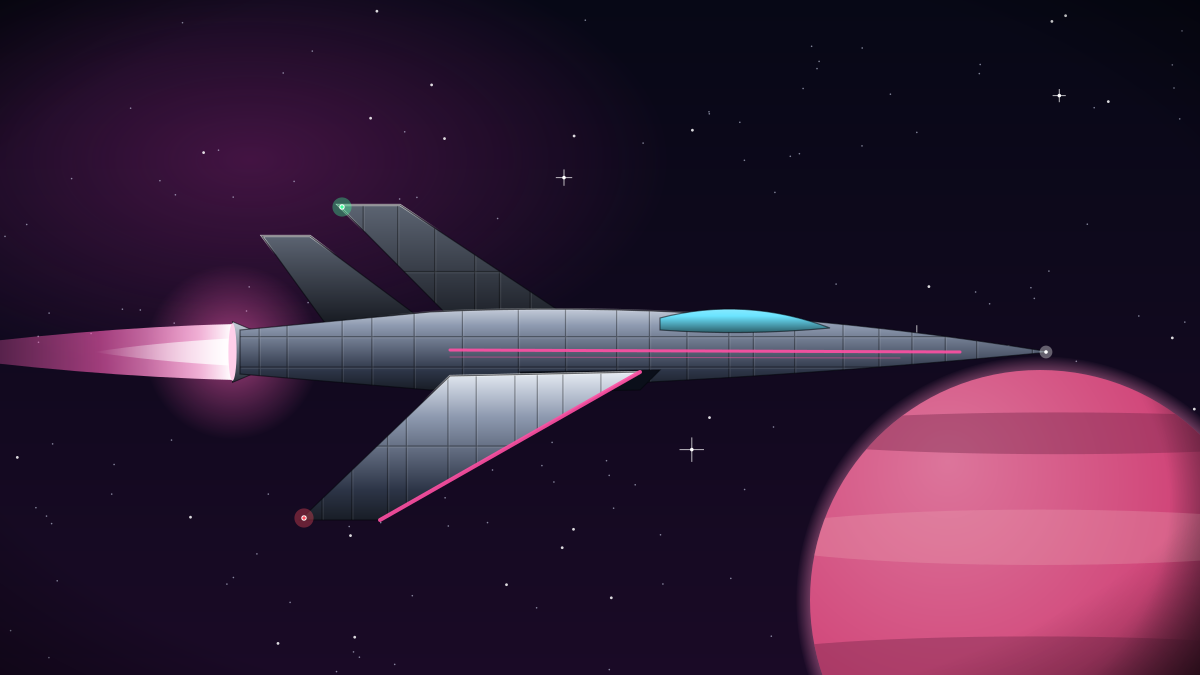
The Aurora Mk II began life in 2181 as a response to a simple complaint from our partners in the Belt: urgent parts, legal documents and biological samples were spending weeks in the holds of slow freighters when they needed to arrive in days. The original Aurora proved the concept but burned fuel at an alarming rate. Head of Propulsion Marguerite Delacroix led the redesign, and the Mk II made its first flight from Kepler Yards on 12 April 2183.
At 28 metres from nose to nozzle, the Mk II is a slender dart built around a single deuterium–helium-3 fusion drive. It reaches a top speed of 1,450 km/s, making it the fastest crewed craft Halcyon has ever produced, and it can reach 60 AU before needing to refuel. Thanks to a regenerative magnetic nozzle, it consumes only 2.1 tonnes of Deuterium-Helium-3 fusion pellets per 100 AU, an extraordinary figure for a vessel this quick.
The cockpit seats one pilot, with a fold-down couch for a single passenger, typically a courier escort, a physician accompanying an organ transplant, or an executive who simply cannot wait. The secure hold carries up to 4 tonnes, enough for a crate of replacement reactor sensors or a refrigerated medical cargo. A typical run from L5 Lagrange Station to Mars orbit takes under four days, and Ceres is reachable in about a week.
Commissioning an Aurora Mk II costs 38.5 million credits, including the first year of autonomy software updates and pilot conversion training at our Luna facility. That price places it well above the 12.8 Mc Kestrel shuttle, but far below the 210 Mc Corvid Stealth Scout, its closest relative in performance. Where the Corvid trades speed for low observability and a 140 AU reach, the Aurora is unapologetically about getting from A to B as fast as physics allows.
Owners describe it as a joy to fly but unforgiving of sloppy planning: with only one helmsman aboard, the flight computer handles most of the long burn and the pilot manages approach and docking. Chief Test Pilot Mateo Silva calls it "the closest thing we build to a racing machine," and express-delivery operators across Luna, Mars and the Belt agree.