Ship
Tempest Ice Runner
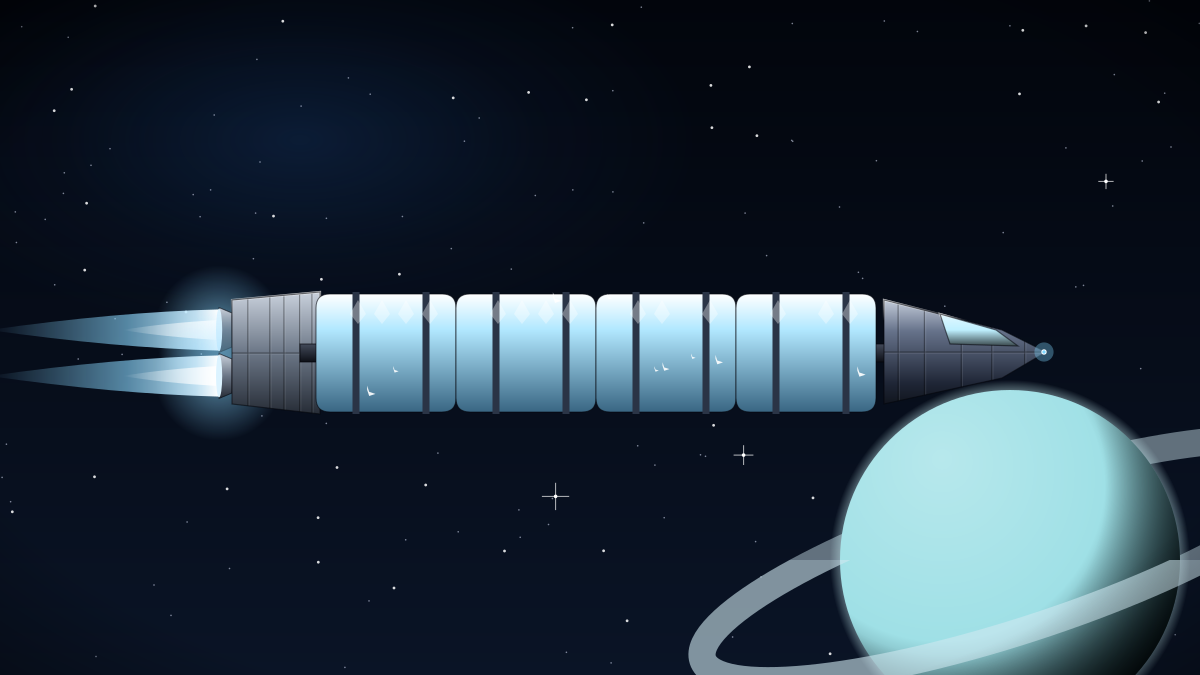
Water is the most valuable commodity in space: it is drinking supply, radiation shielding, oxygen source and rocket propellant all at once. The Tempest Ice Runner was designed to bring it from where it is plentiful, around Saturn and in the outer Belt, to where it is needed. Engineering work began in 2180, and the first Tempest flew on 2 August 2183, returning from Enceladus with a full hold eleven months later.
The ice runner is 410 metres long and flown by three pilots, with a total crew of eight. Its insulated tanks hold 38,000 tonnes of water ice, harvested by an array of melt drills and cryogenic scoops that can be deployed directly onto icy moons. Hull armour is thickened forward to withstand the dust and ice particles of Saturn's rings.
The Tempest's propulsion is unusual in our lineup: a nuclear thermal engine that heats water-derived hydrogen produced from its own cargo. It reaches 380 km/s with a range of 160 AU, and burns 7.6 tonnes of hydrogen per 100 AU. Because it refuels from what it carries, a Tempest effectively never runs dry as long as there is ice to mine.
Commissioning a Tempest costs 520 million credits. That is more than the 410 Mc Atlas Heavy Freighter, which carries more cargo but lacks the ice-harvesting equipment, radiation hardening and outer-system range. For gas rather than ice, operators look to the 235 Mc Nimbus Gas Skimmer.
Most Tempest operators run long loops from Enceladus or Europa to depots in the Asteroid Belt, where water is sold as propellant to Leviathans and Atlases. Account Executive Valentina Rojas, based on Titan, says demand has outstripped supply every year since the ship entered service.
Life aboard is spartan but comfortable. The habitat is buried behind the water tanks, which double as excellent radiation shielding on the long outer-system legs, and the crew of eight rotate through four-month shifts. Radiation Protection Engineer Dmitri Volkov reckons a Tempest crew receives less dose than an Atlas crew in the inner system, simply because they are surrounded by so much ice. Typical voyages last between nine and fourteen months, depending on planetary alignment and how quickly the drills can fill the tanks at Enceladus or Europa.