Ship
Halcyon Starliner
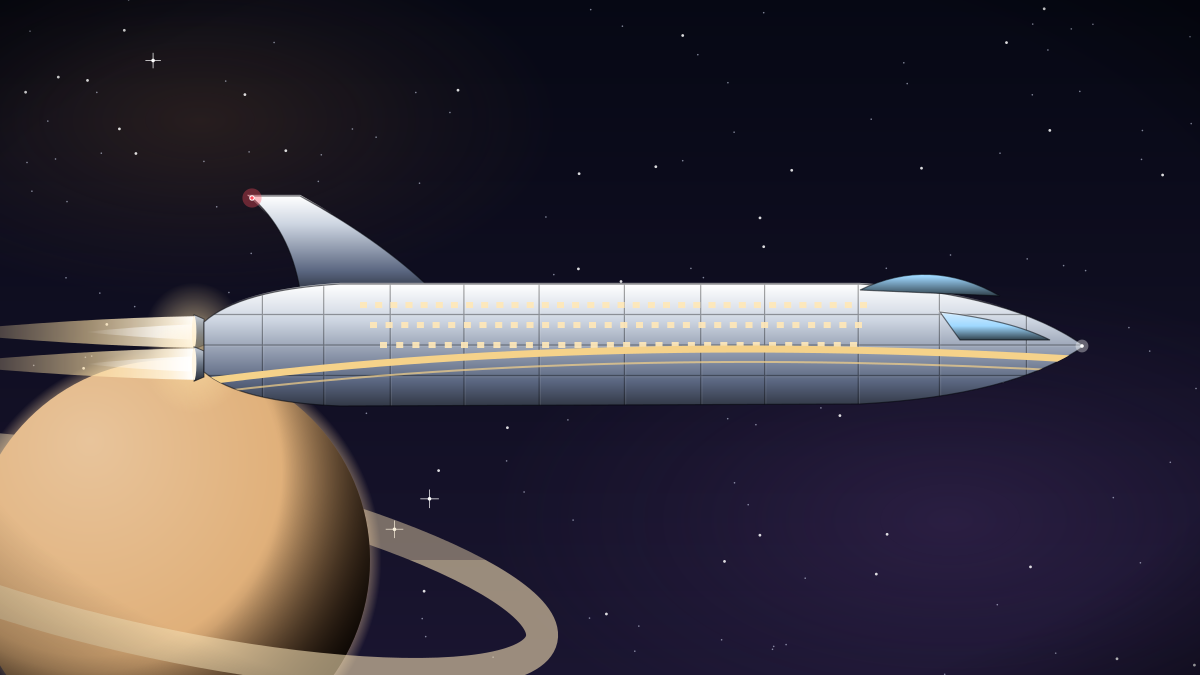
The Halcyon Starliner was designed to make interplanetary travel feel ordinary. Before it entered service, a trip from Earth to Mars meant months aboard a cramped freighter or an expensive charter. The Starliner, first flown on 1 December 2184, changed that, offering scheduled departures, private cabins and spin-gravity decks to 1,200 passengers at a time.
The liner is 520 metres long and flown by four pilots, supported by a total crew of 64 that includes hospitality staff, physicians and engineers. Two counter-rotating habitat rings provide gravity close to Earth's, with restaurants, a library, an observation lounge and a small theatre. Up to 900 tonnes of luggage, mail and priority freight travel in the lower holds.
Propulsion comes from three helium-3 fusion drives, giving a top speed of 520 km/s and a range of 45 AU. That reach covers Earth, Luna, Mars, the Olympus Ring and L5 Lagrange Station with plenty of margin. The ship burns 4.4 tonnes of Helium-3 fusion pellets per 100 AU, and a standard Earth–Mars crossing at favourable alignment takes about five weeks.
Commissioning a Starliner costs 1,680 million credits. The Kestrel shuttle carries eight passengers for 12.8 Mc, but is suited only to short hops; the Meridian Colony Ark carries 4,800 people, but at 8,950 Mc and as a one-way settlement ship. For regular passenger service between worlds, the Starliner has no real competitor.
Head of Industrial Design Noa Ben-David led the interior programme, insisting that every cabin have a window. "If people are going to cross the solar system," she says, "they should see it." Current operators run weekly departures from L5 to Mars, with seasonal routes to Luna.
Safety was treated as seriously as comfort. Every Starliner carries enough lifeboats for all 1,200 passengers and 64 crew, a storm shelter deep in its core shielded by water tanks, and a medical deck staffed around the clock. Interior Design Lead Thiago Santos worked with Human Factors Engineer Isabel Navarro to design cabins that remain usable even in zero gravity, so that passengers can stay comfortable if the habitat rings ever need to be spun down for maintenance or during an emergency manoeuvre. Fares range from economy berths to suites with private observation domes.