Ship
Basilisk Salvage Tug
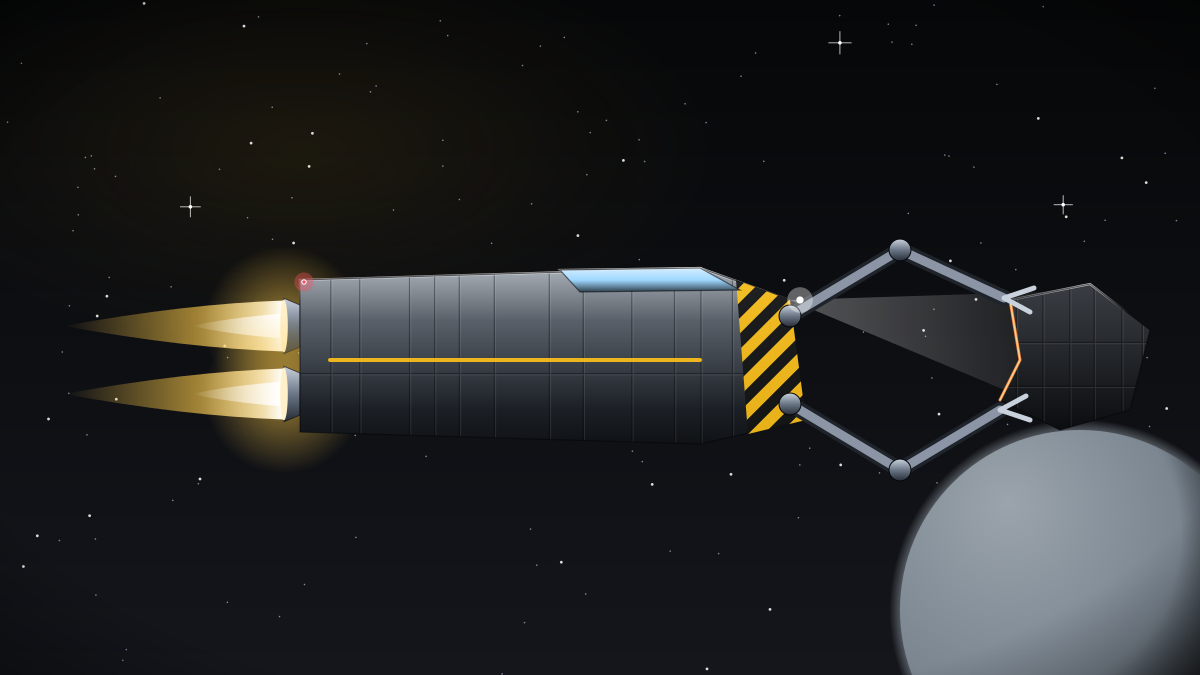
The Basilisk Salvage Tug is a working ship for a messy job. By the late 2170s, Earth and lunar orbits were cluttered with dead satellites, spent stages and abandoned modules. The Basilisk, first flown on 22 July 2180, was built to grab that debris and bring it to recycling yards, and to tow damaged vessels to safety when things go wrong.
At 118 metres, the Basilisk is compact and heavily built. Two pilots fly it, with a crew of five in total, including riggers who operate its three articulated grapples and an electrostatic capture net. It can tow up to 2,400 tonnes, enough to recover a disabled Kestrel or tug a loaded cargo cradle into a dock.
Instead of a fusion drive, the tug uses high-power argon Hall-effect thrusters, which provide precise, steady thrust ideal for docking with tumbling objects. Top speed is 190 km/s, range is 25 AU, and the tug consumes just 3.6 tonnes of argon per 100 AU. Argon is cheap and widely available, which keeps operating costs low.
A Basilisk costs 68 million credits to commission. That is less than the 118 Mc Polaris Relay Tender, which services satellites rather than removing them, and a fraction of the 330 Mc Gravitas Dock Barge used for heavy orbital construction. Many debris contractors run small fleets of Basilisks on government clean-up contracts.
Typical missions include clearing debris from crowded orbits around Earth and Luna, recovering derelicts for scrap at L5, and on-call rescue towing near Mars. Chief Safety Officer Grace Mwangi credits Basilisk crews with preventing at least a dozen collisions in the last two years.
The tug's control station is designed around precision work. Its two pilots sit side by side with an unobstructed view of the grapples, and the autonomy system can hold position within a few centimetres of a tumbling target while the riggers make their capture. Basilisk crews train extensively in simulators at L5 Lagrange Station before taking on live salvage jobs, and many of them were previously Kestrel or Wren pilots. The hull is reinforced to survive impacts from small debris, and a modular workshop allows crews to cut large derelicts into manageable sections before towing them home for recycling and resale.