Ship
Nimbus Gas Skimmer
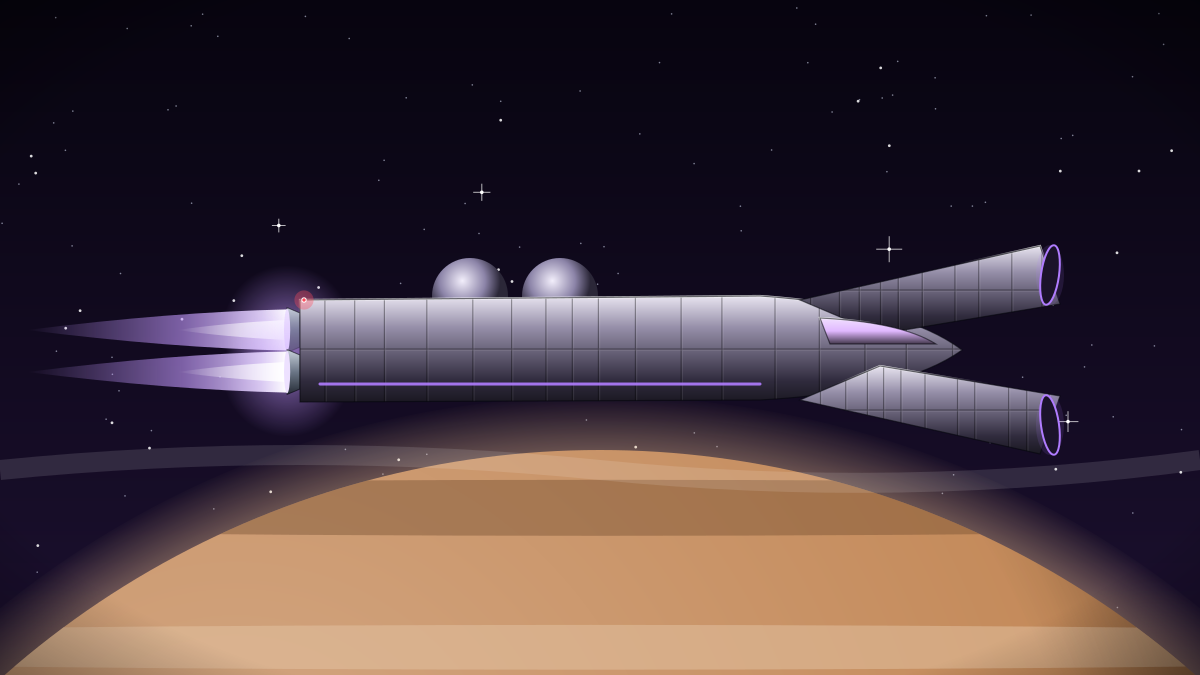
The Nimbus Gas Skimmer brings fuel back from the giant planets. Helium-3, the isotope that powers most of the fusion drives in Halcyon's fleet, is scarce on the Moon but plentiful in the atmospheres of Jupiter, Saturn and Uranus. The Nimbus was designed to fly through those atmospheres and come out with a full tank. It made its first skimming pass over Saturn on 15 March 2185.
The skimmer is 240 metres long, with swept intake wings and a heat shield rated for repeated atmospheric passes at hypersonic speed. Two pilots fly it, with a total crew of six including separation technicians who operate the onboard isotope refinery. It holds 9,000 tonnes of liquefied hydrogen and helium-3 concentrate.
Propulsion is the ship's most elegant feature: a fusion ramjet that burns hydrogen scooped in situ during each pass. As a result, its net fuel consumption is the lowest of any ship we build at a sustained cruise, just 0.6 tonnes per 100 AU. The Nimbus reaches 270 km/s, and its range of 30 AU is enough to deliver cargo from the gas giant to nearby moon depots such as Io, then return for another dive.
Commissioning a Nimbus costs 235 million credits. Paired with a Tempest Ice Runner, which costs 520 Mc and handles water, a Nimbus fleet can supply both propellant and life support for an entire outer-system settlement. Its main competitor is not another ship but the long and expensive supply chain from the Moon.
Fusion Drive Engineer Dev Raman, who worked on the ramjet, says the hardest part was not the engine but the timing: each skimming pass lasts under nine minutes, and the autonomy system must adjust the trajectory dozens of times per second. Nimbus crews describe the dives as the most thrilling flying in the system.
Because each Nimbus refuels itself, operating costs are dominated by crew and maintenance rather than propellant. Heat-shield panels are replaced every forty passes, and a typical skimmer can deliver more than 60,000 tonnes of fuel concentrate per year to depots around Io and Saturn. Most crews fly three-month rotations before handing the skimmer to a fresh team at the depot.