Ship
Polaris Relay Tender
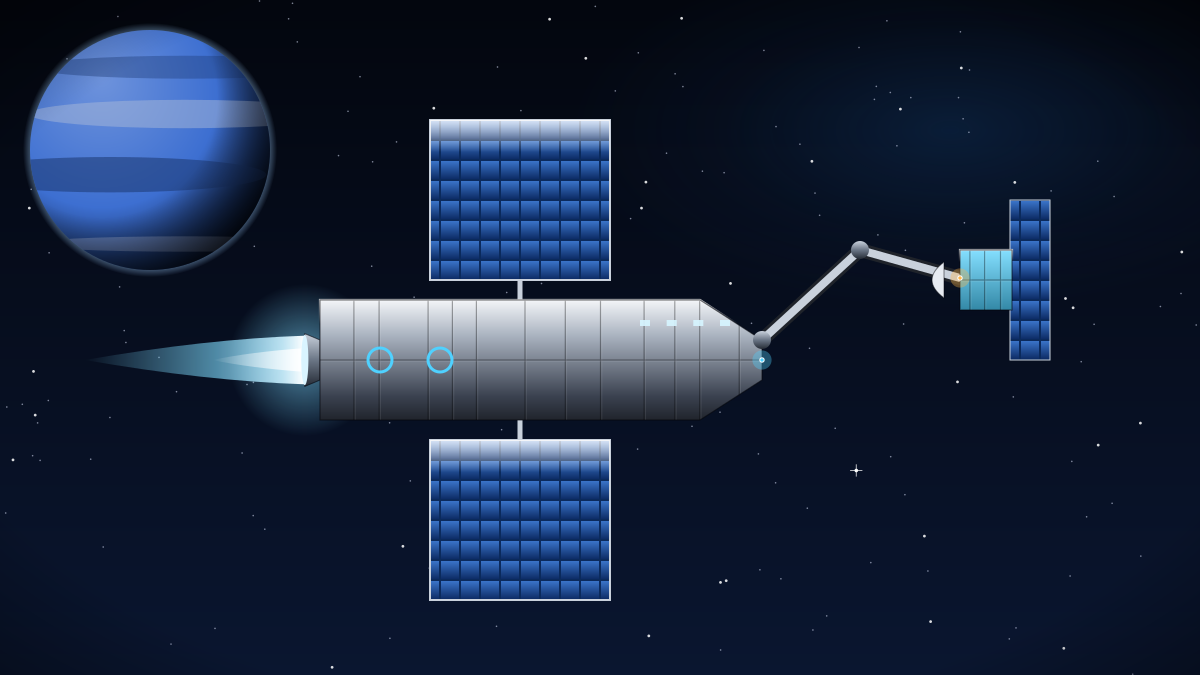
The Polaris Relay Tender keeps the system's communications network alive. Thousands of relay, navigation and survey satellites orbit everywhere from L5 to Jupiter, and every one of them eventually runs low on propellant, suffers a failed component, or needs a software upgrade. The Polaris, first flown on 9 May 2182, was built to fix them in place rather than replace them.
At 88 metres, the tender is flown by two pilots, with a total crew of seven, including robotics specialists who operate its twin seven-axis manipulator arms from a pressurised control room. A workshop bay can fabricate replacement parts, and 320 tonnes of spares, propellant tanks and new instrument packages ride in the hold.
The Polaris uses xenon ion propulsion: slow to accelerate but extremely efficient, reaching a top speed of 330 km/s and a range of 55 AU while burning only 1.4 tonnes of xenon propellant per 100 AU. Gentle, precise thrust is ideal for station-keeping beside fragile satellites for days at a time.
Commissioning a Polaris costs 118 million credits. Operators who need debris removal rather than repair choose the 68 Mc Basilisk Salvage Tug, while those building new infrastructure from scratch use the 330 Mc Gravitas Dock Barge. In the satellite-servicing niche, the Polaris is the industry standard.
Typical missions include refuelling Mars relay constellations above Phobos, upgrading navigation beacons at L5, and replacing antennas on Jovian survey satellites. Flight Software Lead Jonas Lindqvist notes that most of the Polaris's capture and docking routines are published as open source.
The tender's arms are its signature. Each one can lift two tonnes in microgravity, swap components with sub-millimetre precision, and can be controlled either by the onboard robotics team or by operators on the ground with a short enough signal delay. A Polaris can service a satellite in as little as six hours, compared with the months it would take to build and launch a replacement. Many relay operators across Mars, Phobos and Jupiter sign multi-year servicing contracts covering their whole constellation, and the tender often spends weeks moving from satellite to satellite along a single orbit before returning to port.