Ship
Cascade Dropship
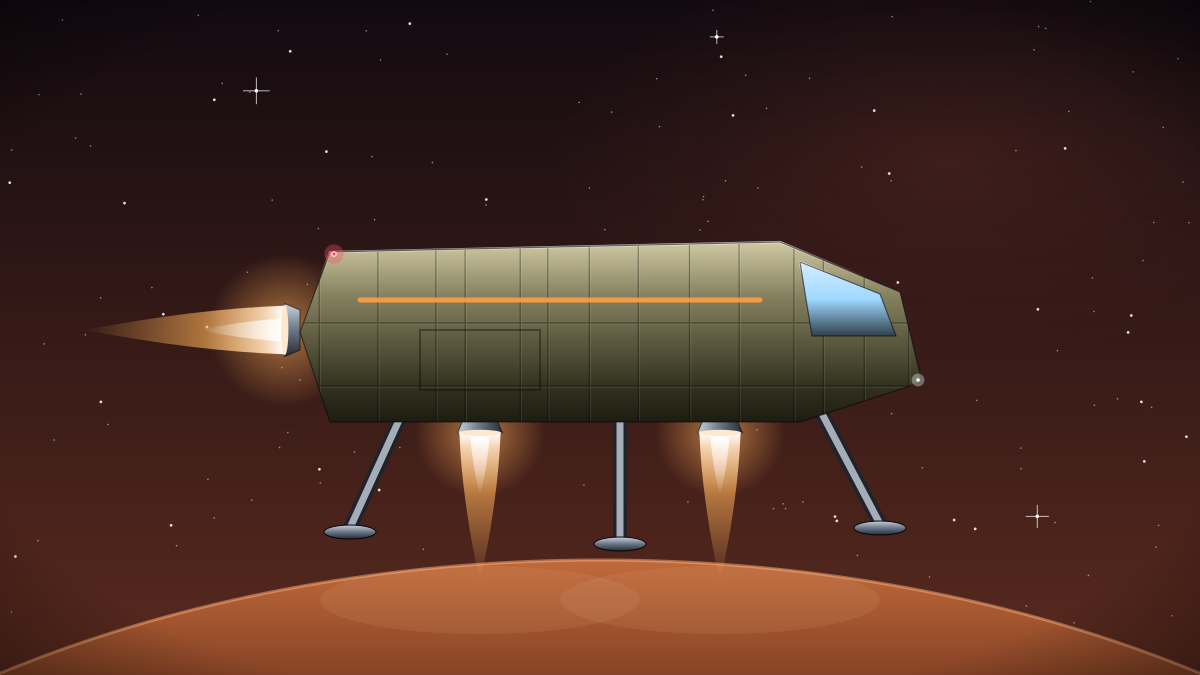
The Cascade Dropship is the heavy-lift link between orbit and the ground. Colony and mining projects on Mars, Luna, Titan and Ganymede need to land habitats, vehicles and people in large quantities, and the small Wren Microlifter cannot keep up. The Cascade, first flown on 11 February 2183, carries 220 tonnes per trip and climbs back to orbit to do it again.
The lander is 72 metres tall and is flown by two pilots, with a total crew of six, including loadmasters and a surface operations officer. It carries either 220 tonnes of cargo or up to 60 passengers in a modular cabin. Landing legs adjust automatically to slopes of up to 15 degrees.
Methalox engines, burning liquid methane and liquid oxygen, give the Cascade a top speed of 140 km/s and a range of 12 AU. Fuel consumption is 18.0 tonnes per 100 AU, high on paper but irrelevant for most missions, which are short ascents and descents. Methalox can be produced locally on Mars and Titan.
Commissioning a Cascade costs 185 million credits. Every Meridian Colony Ark carries a complement of Cascades in its belly bay, and settlement authorities often buy additional units to support construction. Compared with the 6.4 Mc Wren, the Cascade costs far more but lifts seventy times the cargo.
Lead Systems Engineer Lucía Ferreira and Test Pilot Zanele Dlamini spent two years refining the Cascade's landing autonomy in Martian dust storms. Today, Cascades fly daily schedules between the Olympus Ring and the Martian surface.
The dropship's design emphasises turnaround speed. Ground crews can unload a full cargo pallet, refuel and relaunch a Cascade in under three hours. Its engines are rated for 300 flights between overhauls, and its heat shield is fully reusable. For passenger missions, the cabin can be fitted with radiation shielding and seating for 60, making it a common sight carrying settlers from a Meridian Colony Ark down to new towns on Mars, Titan and Ganymede. Mining operators on Luna also use Cascades to bring heavy drilling rigs down to the surface and return ore samples to orbit. Over 140 Cascades are now in service across four worlds.