Ship
Eidolon Lightsail Prototype
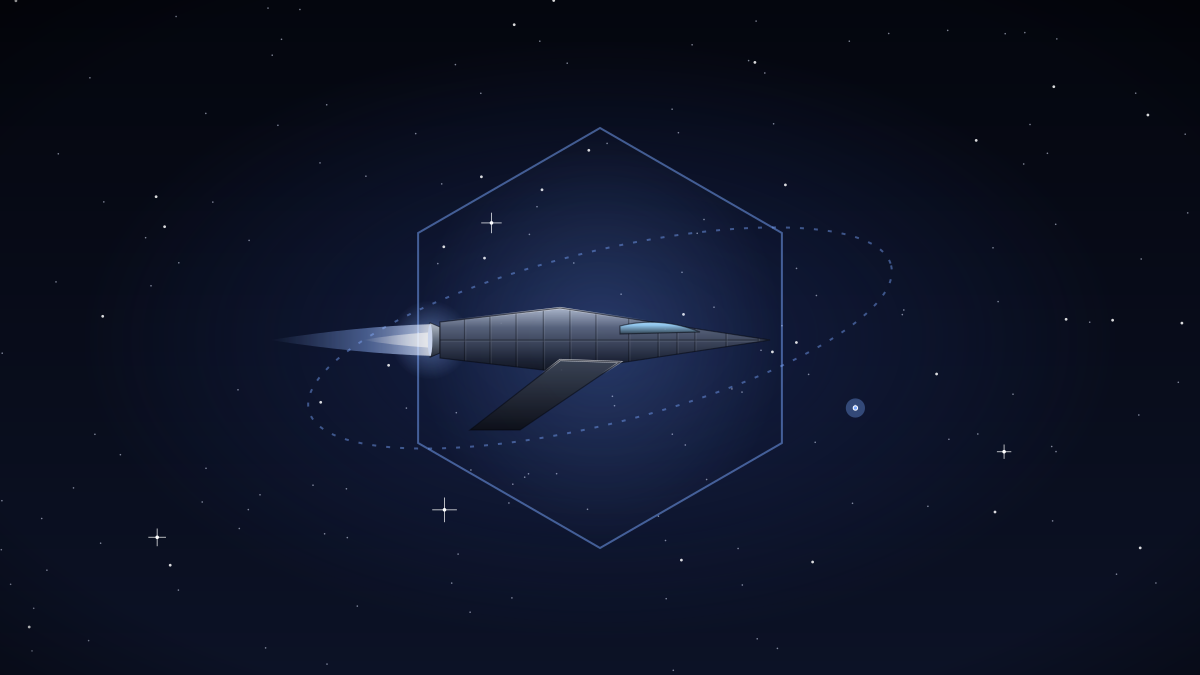
The Eidolon Lightsail Prototype is Halcyon's bet on the future. Every other ship in our catalogue is bound to the solar system; the Eidolon is meant to prove that people can travel to another star. Its target is Proxima Centauri b, 4.2 light-years away. The prototype made its first flight on 4 March 2187, unfurling its sail beyond Neptune's orbit.
The Eidolon has a 640-metre craft structure and a sail several kilometres across made of a reflective graphene composite. Instead of carrying fuel for the main voyage, it rides a beam of laser light from a ring of transmitters near L5 Lagrange Station. A single pilot oversees the flight, with a total crew of four for research. Its cargo capacity is limited to 1 tonne of instruments.
Design range is 265,000 AU, roughly the distance to Proxima, at a peak cruise speed of 14,800 km/s. Since the sail requires no onboard propellant, its fuel use is just 0.02 tonnes per 100 AU, consumed by helium-3 trim thrusters used for steering and docking. Laser-pushed lightsail propulsion makes it unlike any other ship we build.
The Eidolon programme has cost 3,400 million credits to date, making it the second most expensive vessel after the 8,950 Mc Meridian Colony Ark. It is not for sale: Halcyon funds the programme with research partners, and the long-term goal is a crewed version capable of reaching Proxima within a human lifetime.
Lightsail Research Lead Kwame Asante calls the Eidolon "the most important experiment we've ever run." Current tests focus on beam stability and sail durability beyond Neptune, with an uncrewed probe to Proxima planned next.
Building the Eidolon required breakthroughs in materials, navigation and laser control. Principal Structural Engineer Haruto Nakamura's team developed folding techniques that let the sail deploy without tearing, while the autonomy team built navigation software that can steer by adjusting the sail's reflectivity. Every test flight produces data that Halcyon publishes through its open data programme, inviting researchers across the system to analyse the results and propose improvements to the beam and sail design. The next milestone, a fully crewed endurance trial beyond Neptune lasting six months, is scheduled for late 2188.