Blog post
Quiet hours: riding along on a Corvid patrol in the Belt
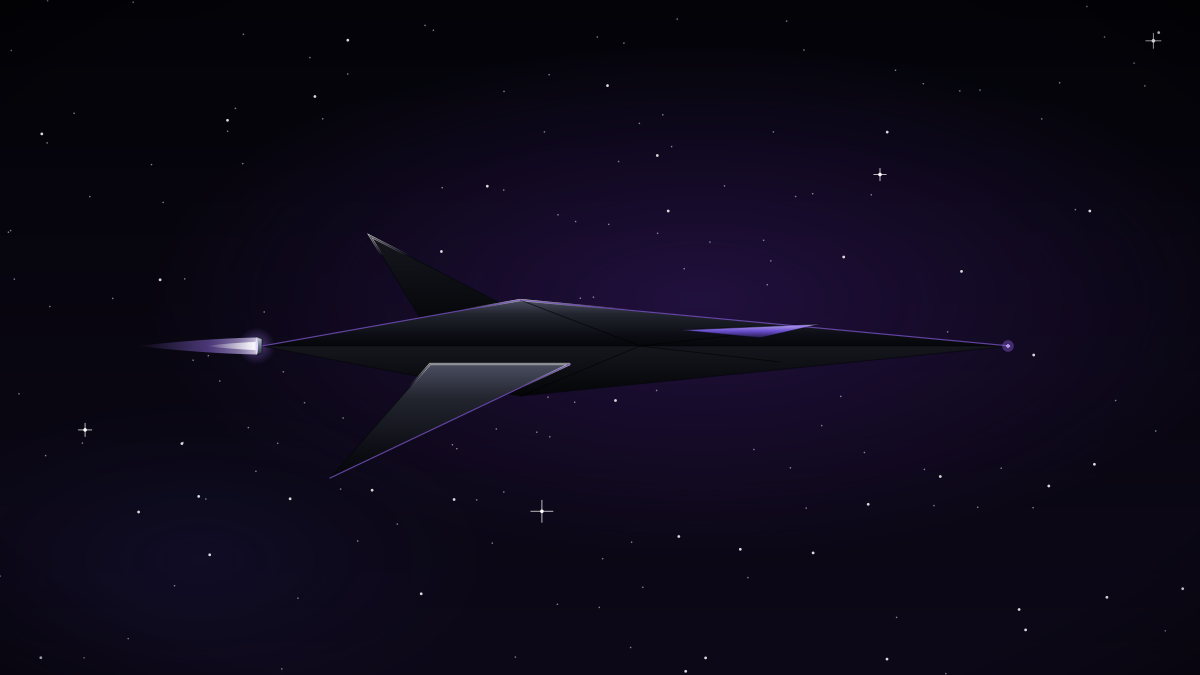
The Corvid Stealth Scout is designed for one pilot. There is technically a second seat, folded against the rear bulkhead, and for five days in the outer Belt it was mine. I was there because people ask us about the Corvid more than almost any other ship we build, and because I wanted to describe it honestly.
First, what the Corvid is not. It is not a warship. It carries no weapons. Its job is to watch quietly and report accurately. Its low-signature hull, 36 metres long, is shaped and coated to make it hard to see on radar and infrared, and its helium-3 drive can be run in a cold mode that trades speed for stealth. Flat out, it reaches 1,100 km/s; on patrol, it barely moves.
Our pilot was a former survey captain contracted to a Belt claims registry. Most of her work is verifying mining claims: confirming that the rock someone registered is the rock they are actually cutting into. Disputes over claims cause more violence in the Belt than any pirate ever did, and an independent observer with timestamped sensor data settles most of them before they escalate.
On day three we tracked a hauler running dark near a registered claim. It was not a Leviathan; it was an older, unregistered craft with its transponder off. The Corvid shadowed it for eleven hours at 4,000 kilometres without being detected, logged its course, and relayed the data to registry authorities on Ceres. Two days later, the hauler's operators were boarded and fined. Nobody was hurt.
That is the Corvid's real value. With a range of 140 AU and fuel consumption of just 1.2 tonnes per 100 AU, a single scout can cover a vast patch of sky for weeks. At 210 million credits it is not cheap, but registries tell us one scout prevents more lost revenue each year than it costs.
Life aboard is spartan. The cabin is roughly the size of a small car, the galley is a drawer of ration packs and the toilet is best not described. The pilot sleeps in four-hour shifts while the autonomy system holds station and watches the sensors. She told me the hardest part of the job is not danger but boredom, and the discipline to stay sharp on day twenty of a patrol when nothing has happened since day two.
I came home with 30 hours of interview audio and a strong appreciation for silence. The Corvid is the quietest place I have ever been.