Ship
Kestrel
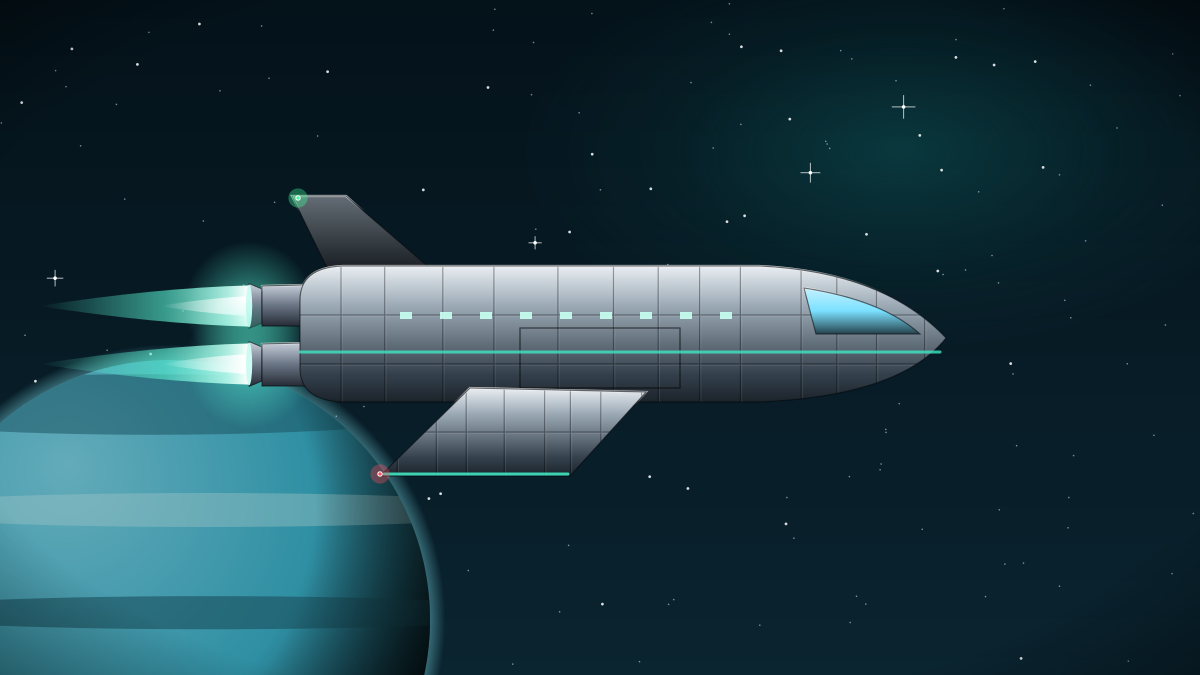
The Kestrel is the oldest design still rolling off our lines and, by unit count, the most successful ship Halcyon has ever built. First flown on 3 September 2179, it was conceived as an honest, affordable shuttle for the busy corridor between Earth orbit, Luna and L5 Lagrange Station. Nearly a decade later, it remains the default answer when a commuter operator asks for something cheap, reliable and easy to crew.
The Kestrel measures 34 metres and is flown by two pilots, with a third crew member serving as loadmaster and cabin attendant. It seats eight passengers in a pressurised cabin and carries 6 tonnes of luggage or freight. Its twin methalox engines, burning liquid methane and liquid oxygen, give it a top speed of 310 km/s and a practical range of 14 AU, which is far more than any cislunar route needs and lets operators push out to near-Earth asteroids when the work calls for it.
Fuel use is the Kestrel's one weakness compared with its fusion-powered siblings. It consumes about 9.5 tonnes of methalox per 100 AU, several times the 2.1 tonnes of the Aurora Mk II. In practice, cislunar hops are short, and methalox depots are everywhere between Earth and Luna, so operators rarely notice. The trade-off is simplicity: chemical engines need no fusion licence, no reactor-qualified crew and very little specialist maintenance.
At a commissioning cost of 12.8 million credits, the Kestrel is one of the least expensive crewed ships in the system, undercut only by the 6.4 Mc Wren Microlifter and the 4.1 Mc Sparrow Trainer. Unlike those craft, though, it carries a meaningful payload of people. Many flight schools graduate students from the Sparrow straight into the right-hand seat of a Kestrel.
Typical missions include crew rotations to Shackleton Base, tourist excursions around the Moon, ferry runs to L5 and short-notice charters. Sales Engineer Kenji Watanabe notes that a well-run Kestrel fleet can fly four round trips a day between low Earth orbit and Kepler Yards, with turnaround times under ninety minutes.
Because the airframe has been flying since 2179, spares are cheap and mechanics on every cislunar station know it inside out, which keeps unscheduled downtime remarkably low.