Ship
Odyssey Deep Explorer
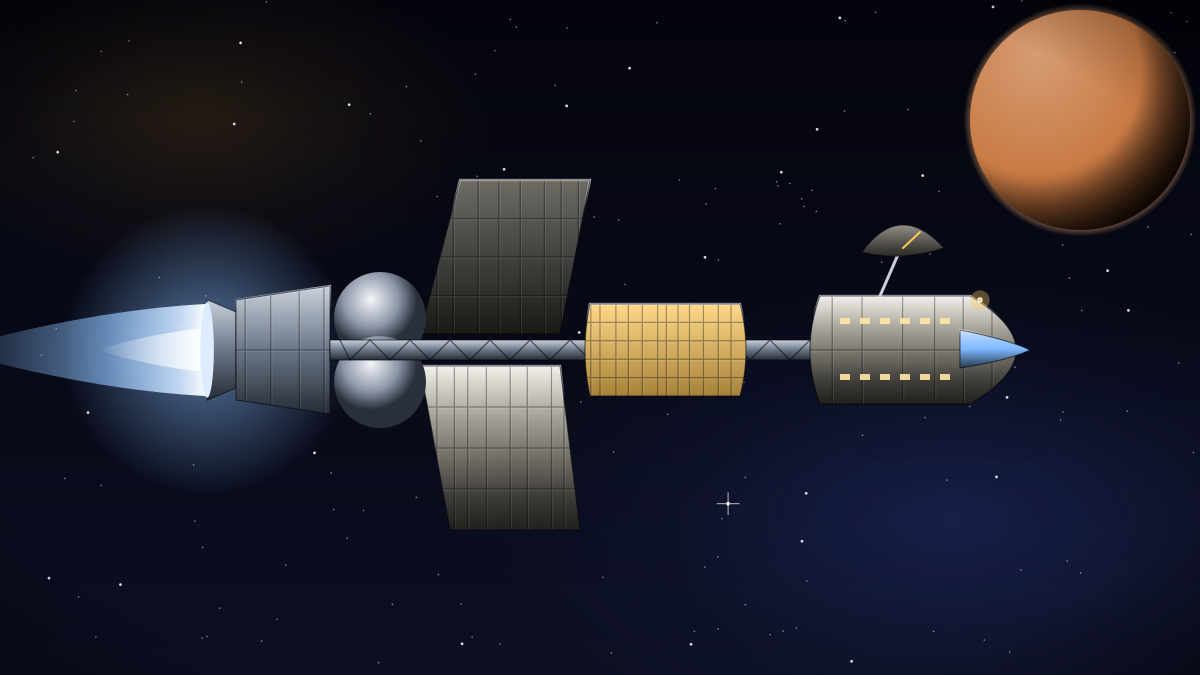
The Odyssey Deep Explorer is the ship that put Halcyon on the map as more than a builder of shuttles and freighters. When a consortium of universities asked in 2177 for a vessel that could carry a full science team to Neptune and bring them home again, nobody in the industry had a credible answer. Four years of work by Engineering VP Nkechi Adeyemi's team produced the Odyssey, which made its maiden flight on 21 June 2181.
The explorer is 196 metres long and flown by four pilots working in rotating watches, supported by a total complement of 18 crew and room for six visiting scientists. A closed-loop habitat ring recycles water and air at better than 98 percent efficiency, allowing expeditions of up to six years without resupply. Its main drive burns Helium-3 fusion pellets and reaches a top speed of 920 km/s.
Endurance is the Odyssey's defining trait. With a range of 1,800 AU, it can reach the ice giants, survey the Kuiper belt and return without touching a depot. Fuel economy is outstanding: just 0.85 tonnes of helium-3 per 100 AU, the best of any conventionally fuelled ship in our catalogue. By comparison, the Valkyrie Survey Corvette reaches 220 AU and burns 1.9 tonnes per 100 AU.
The hold carries 1,200 tonnes of instruments, landers, sample freezers and spares. Missions to date have included a three-year survey of Triton's geysers, a gravitational mapping campaign around Uranus and the first crewed flyby of a long-period comet. Operators mount everything from atmospheric probes to deep-drilling rigs on the modular payload spine.
Commissioning an Odyssey costs 1,240 million credits, placing it among the most expensive vessels we build, behind only the Halcyon Starliner, the Eidolon prototype and the Meridian Colony Ark. For agencies planning a decade of outer-system science, though, the cost per research-day is lower than any alternative, which is why seven national science agencies now fly one.
Owners also value the explorer's redundancy: every critical system is duplicated, and the reactor can be serviced in flight by the crew. Avionics Engineer Rafael Quispe designed its triple-redundant navigation core, which has logged over 40 million kilometres without a single uncommanded fault.