Ship
Leviathan Ore Hauler
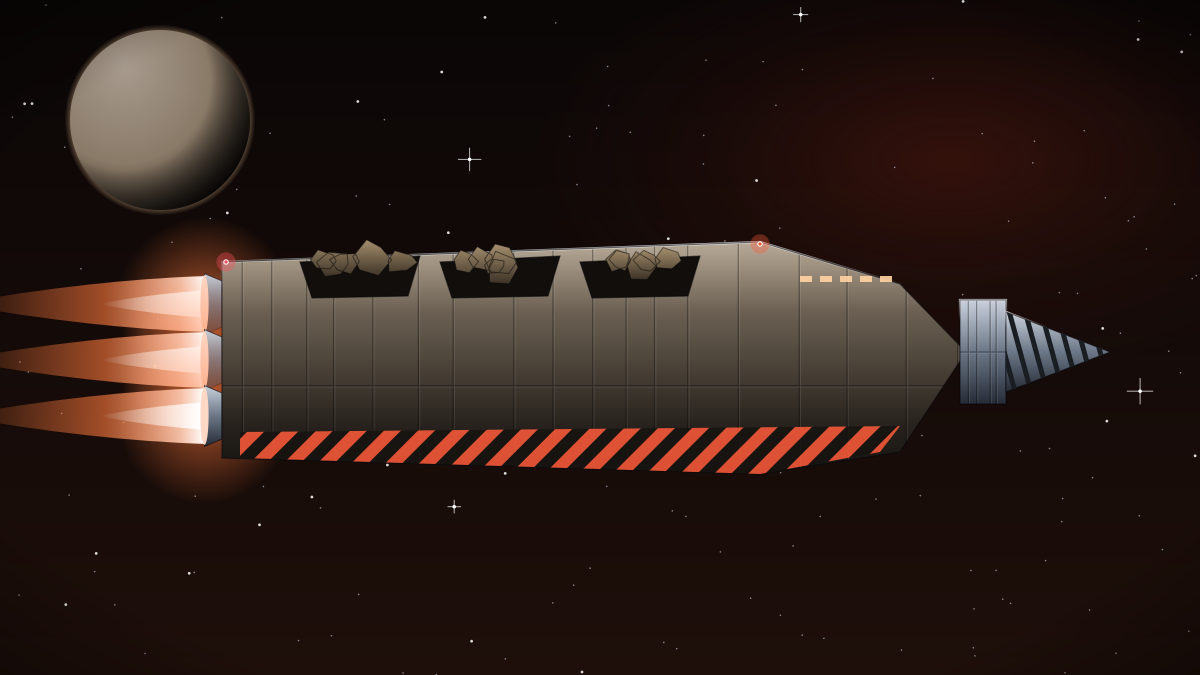
The Leviathan Ore Hauler exists because the Asteroid Belt became too productive for anything smaller. By 2179, smelters on Ceres and Vesta were turning out more refined nickel-iron and platinum-group metals than the existing freighter fleet could carry. Halcyon's answer, first flown on 30 November 2182, was the largest working cargo ship ever built, a vessel designed to move mountains, quite literally, to Mars and Luna.
The hauler stretches 880 metres and carries an astonishing 140,000 tonnes of refined ore in armoured bulk bays. Six pilots share the flight deck in shifts, and a full crew of 22 includes reactor technicians, cargo masters and a medical officer for the long transits. Its deuterium fusion slurry drive is tuned for brute thrust rather than speed, giving it a top speed of 160 km/s and a range of 40 AU.
Fuel consumption is high in absolute terms, 11.4 tonnes of Deuterium fusion slurry per 100 AU, but the Leviathan moves nearly three times the cargo of an Atlas Heavy Freighter, which burns 6.8 tonnes over the same distance. Measured per tonne delivered, it is the cheapest way to move metal across the inner system, and deuterium is refined at every major Belt station.
Commissioning a Leviathan costs 760 million credits. Most are owned by mining consortia who run them on a fixed loop from Ceres to the Olympus Ring yards above Mars and back, a round trip of roughly five months. A few operators pair them with Basilisk Salvage Tugs, which at 68 Mc each are ideal for nudging the loaded giants into docking cradles.
Yard Operations Director Arjun Mehta oversees final assembly at the Olympus Ring, where each hull takes fourteen months to complete. The ship's hull plating is itself made from Belt iron, a fact the crews who fly it are fond of pointing out: every Leviathan is built, in part, from the cargo its sisters delivered.
Crews typically sign on for two consecutive loops, and the habitat section includes a gym, hydroponic garden and private cabins to make ten months aboard bearable. Radiation Protection Engineer Dmitri Volkov designed the ore-lined storm shelter at the heart of the ship, which uses part of the cargo itself as shielding during solar events.