Ship
Valkyrie Survey Corvette
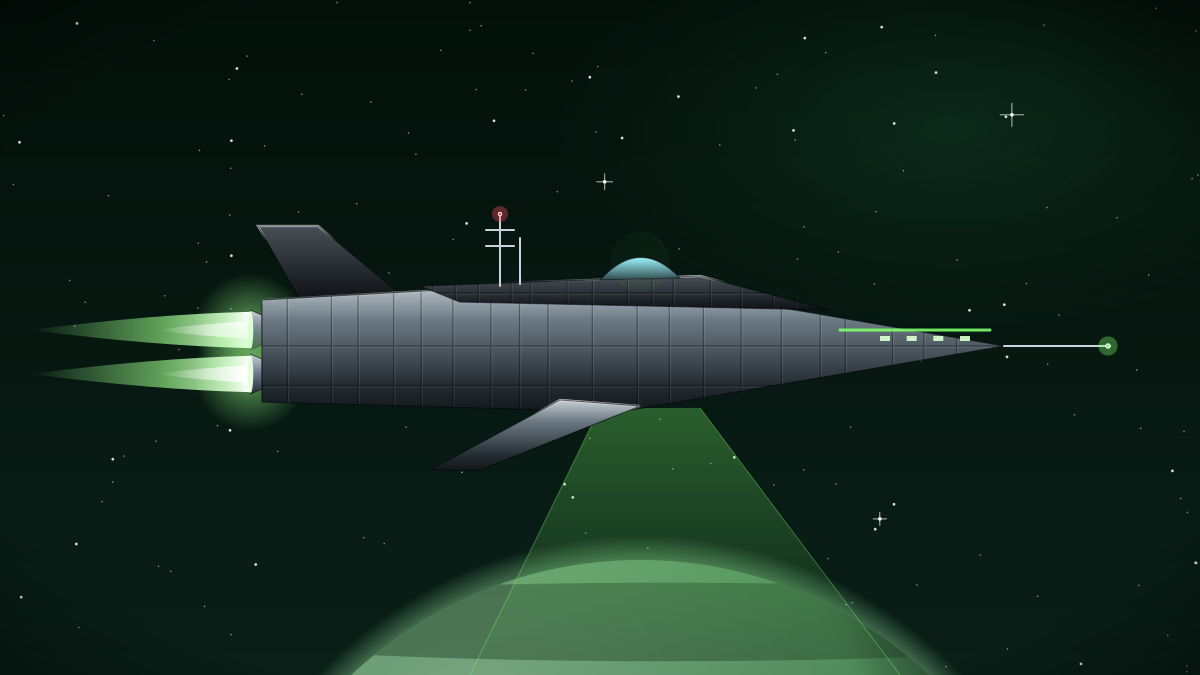
The Valkyrie Survey Corvette is the ship prospectors and planetary scientists call when they need to know exactly what is out there. Developed from 2179 onward, it pairs a compact, agile hull with the densest sensor suite Halcyon has ever integrated. Its first flight on 8 October 2181 was a ten-day mapping run around Vesta that produced the most detailed mineral chart of the asteroid to date.
At 92 metres, the corvette is flown by two pilots, with four more crew operating instruments, for a total of six, plus berths for two guest specialists. Its sensor mast combines lidar, ground-penetrating radar, gravimetry, magnetometry and hyperspectral imaging, all feeding an onboard analysis cluster that turns raw returns into survey-grade maps in hours rather than weeks.
A helium-3 fusion drive gives the Valkyrie a top speed of 860 km/s and a range of 220 AU, enough to survey the Jovian and Saturnian moons in a single deployment. It burns just 1.9 tonnes of Helium-3 fusion pellets per 100 AU, efficient enough that many survey campaigns finish without refuelling. The 180-tonne hold carries landers, penetrator probes and sample return canisters.
Commissioning a Valkyrie costs 145 million credits. Customers wanting to go further usually step up to the 1,240 Mc Odyssey Deep Explorer, which carries far more people and reaches 1,800 AU, while those working close to home sometimes choose the Polaris Relay Tender for its robotic arms. For pure mapping work, the Valkyrie is unmatched.
Typical missions include claim verification for mining companies in the Asteroid Belt, ice-thickness surveys on Europa, and atmospheric profiling over Saturn. Data Scientist Hana Park and the Open Data team publish anonymised Valkyrie survey sets so that anyone can build on the maps these ships produce.
The corvette's flight deck was designed with survey crews in mind. Cockpit UX Designer Leilani Akana gave the two helmsmen a shared tactical display that overlays live sensor returns on the planned track, so pilots and scientists can adjust the survey pattern on the fly. Turnaround between campaigns is quick: a refit at Ceres or Kepler Yards can swap the instrument mast for a different configuration in under a week, letting a single hull serve a prospector one month and a university the next.