Ship
Wren Microlifter
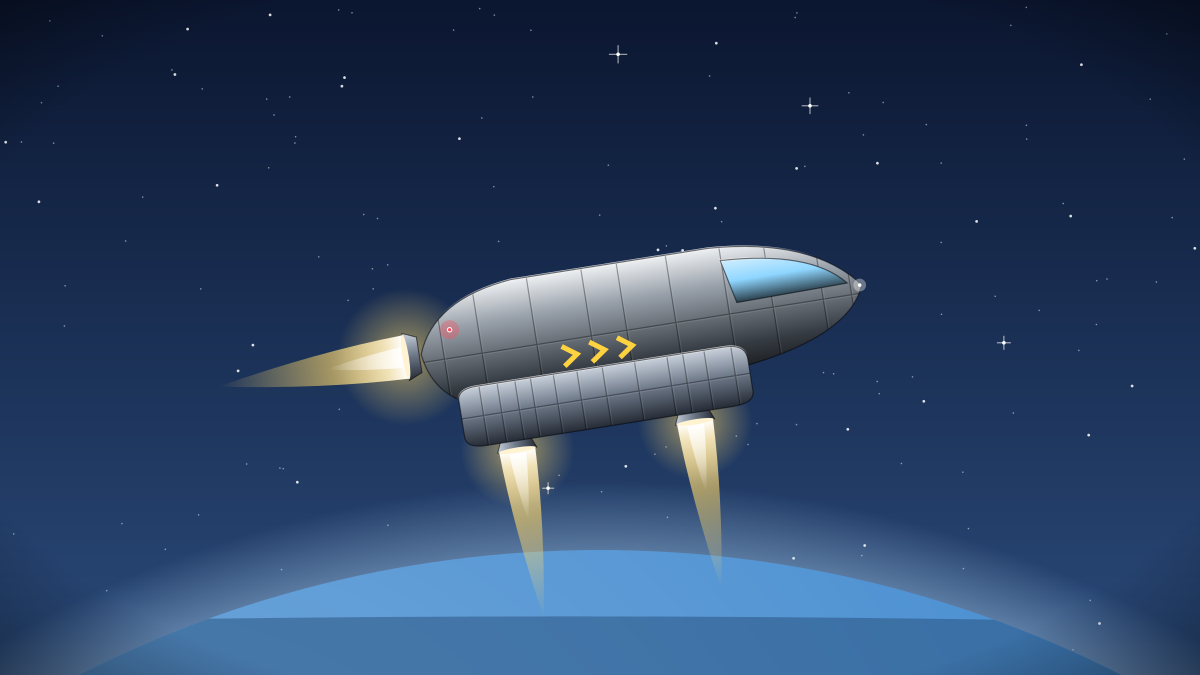
The Wren Microlifter is the smallest crewed craft Halcyon makes and, for many people on Luna and Mars, the most familiar. First flown on 17 May 2179, the same year as the Kestrel, it was designed to do one job well: lift a person and a little cargo from a planetary surface to low orbit, and bring them back down again, as cheaply and safely as possible.
The Wren is just 14 metres tall and is flown by a single pilot, with seats for two passengers and room for 3 tonnes of cargo. Its methalox engine, burning liquid methane and liquid oxygen, delivers a top speed of 9.8 km/s, enough for orbit around Luna, Mars or Phobos, and with a booster stage from Earth. Its nominal range of 2 AU matters less than its ability to fly ten sorties a day from a dusty landing pad.
Fuel use is the highest in our catalogue relative to distance, 28.0 tonnes per 100 AU, but that number is misleading: the Wren almost never flies interplanetary distances. On a typical Martian surface-to-orbit hop it burns well under a tonne. Methalox can be produced locally on Mars and Luna from water ice and atmospheric carbon, so Wren operators rarely depend on imported fuel.
At 6.4 million credits, the Wren is one of the cheapest crewed craft on the market, more expensive only than the 4.1 Mc Sparrow Trainer. Many small businesses on Mars own two or three, and a typical operator recovers the commissioning cost within eighteen months of ferry work. For larger loads, the 185 Mc Cascade Dropship lifts 220 tonnes, but at nearly thirty times the price.
Pilot Training Manager Ana Kalani points out that the Wren shares its cockpit layout with the Sparrow, so graduates convert in just two weeks. Typical missions include crew transfers to orbiting freighters, emergency medical lifts and survey trips to Phobos.
Its simplicity is its greatest strength. A Wren can be refuelled, inspected and relaunched in about forty minutes, and its airframe has been rated for 5,000 landing cycles, far more than most operators will ever use. Spares are stocked at every major port from Earth to Phobos.