Satellites & data
Lantern Deep-Space Relay Constellation
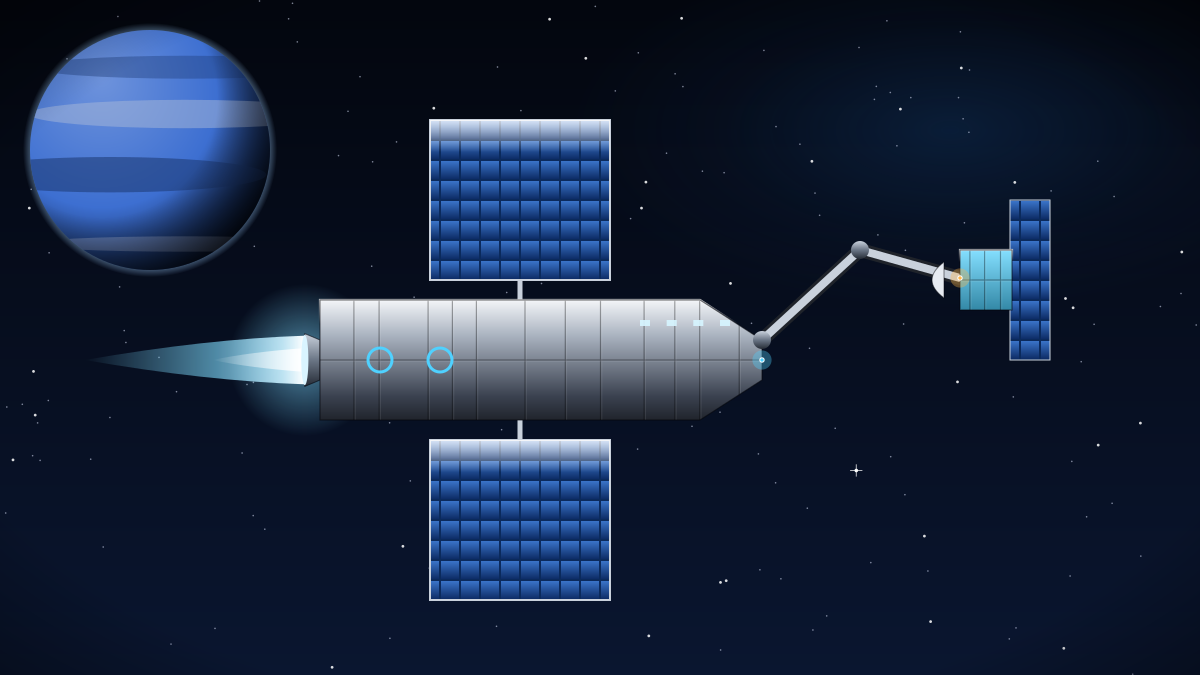
Lantern is the communications spine of Kepler Yards. Six relay satellites hold a loose halo formation around the L5 Lagrange point, each carrying four steerable laser terminals capable of 40 gigabits per second. Traffic from ships in transit, from Shackleton Base on Luna and from ground campuses in Toulouse, Nairobi and Osaka is stitched together here before being forwarded to Mars and the Belt.
Because the relays sit in a gravitationally quiet spot they need very little station-keeping, but their optics degrade slowly from micrometeoroid pitting. Every eighteen months a Polaris Relay Tender rendezvouses with each satellite to swap terminal heads and top up xenon. The servicing logs are part of the public dataset.
Halcyon publishes link availability, latency histograms and a free public timing signal that any spacecraft in cislunar space can use to discipline its clocks. Partners that run their own fleets, from freight lines to research institutes, rely on the uptime reports when planning critical burns.
The constellation's control software is built on the open Tether protocol. Engineers who want to contribute can start with the link-simulation notebooks in the repository, which reproduce a day of real Lantern traffic. In practical terms, users can download laser relay uptime reports, link budget telemetry and public timing signal free of charge under CC-BY-4.0, with source and documentation at https://git.halcyon.example/lantern-relay. Halcyon's open data programme treats this resource as shared infrastructure, much like a lighthouse: it costs little to run once built, and it makes the whole solar system safer and cheaper to work in. Issue reports, documentation fixes and translations are all valued contributions.