Blog post
Cleaning up our own front yard: Basilisk tugs at L5
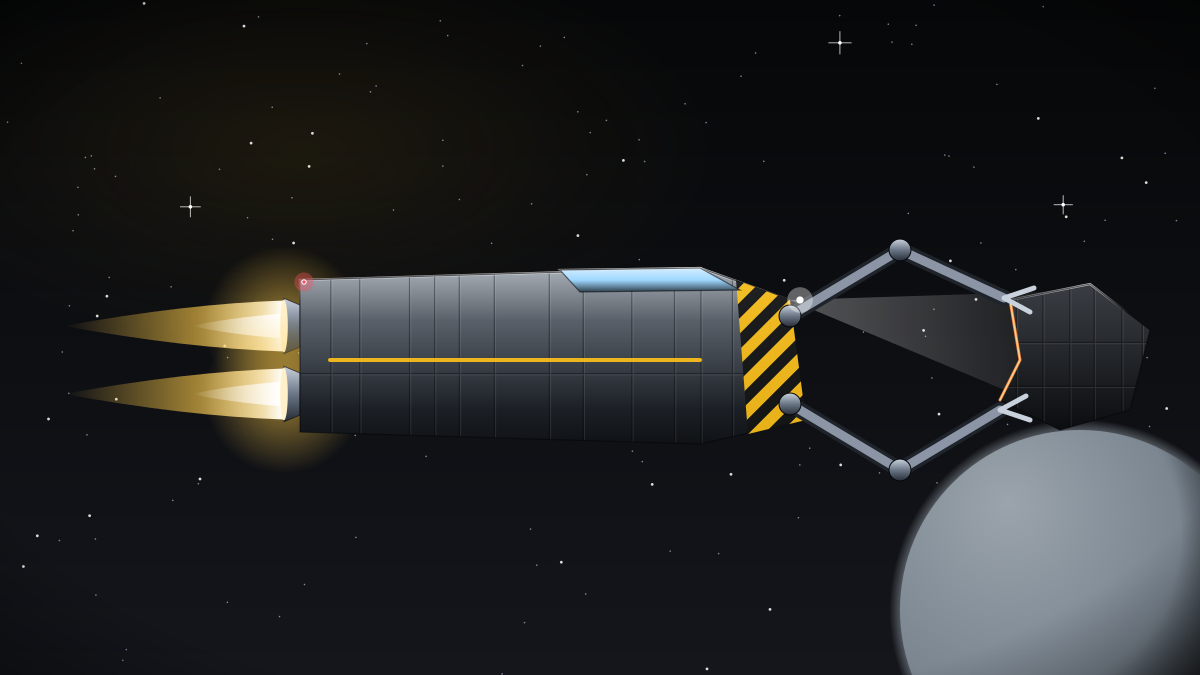
Kepler Yards sits at L5 Lagrange Station because the location is stable. Unfortunately, that stability works for junk too. Spent stages, abandoned construction frames and dead satellites drift into the L5 region and stay there. After eighty years of activity, the neighbourhood around our headquarters had become crowded.
Last year one of my European clients, an orbital services company, proposed a joint clean-up campaign. They supplied the crews; Halcyon supplied a discounted lease on four Basilisk Salvage Tugs and access to our recycling yard. Over nine months, the tugs removed 61 objects with a combined mass of just over 46,000 tonnes.
The Basilisk is built for exactly this. It is 118 metres long, flown by two pilots with three support crew, and it can grapple and tow up to 2,400 tonnes. Its argon Hall-effect thrusters are slow, topping out at 190 km/s, but efficient: about 3.6 tonnes of propellant per 100 AU. For a tug that spends most of its life moving at a crawl, that efficiency is what makes the economics work.
The most difficult job was a 2,100-tonne habitat frame tumbling at four revolutions per minute. The crew spent two days matching its spin before attaching a grapple. One of the pilots described it as trying to shake hands with a spinning door. They despun it, towed it to the yard and cut it up for alloy. About 70 percent of the material was recovered and is now part of a Gravitas barge.
At 68 million credits each, Basilisks are among the most affordable ships we build. The campaign's total cost, including fuel, crew and processing, was recovered within 14 months through recycled-metal sales and reduced collision-avoidance manoeuvres for the yard's own traffic.
The campaign also produced a useful dataset. Every object removed was catalogued, photographed and measured before it was cut up, and the results now form part of our L5 debris survey on the Halcyon open data portal. Researchers studying how materials age in deep space have already started using it. A 60-year-old aluminium frame tells you a great deal about micrometeoroid erosion and radiation embrittlement, information that feeds directly back into how we design long-lived hulls.
We are now talking with operators near Luna and Mars about similar campaigns. Clean orbits are not charity. They are infrastructure.