Blog post
Inside the Odyssey's closed-loop habitat: six years without resupply
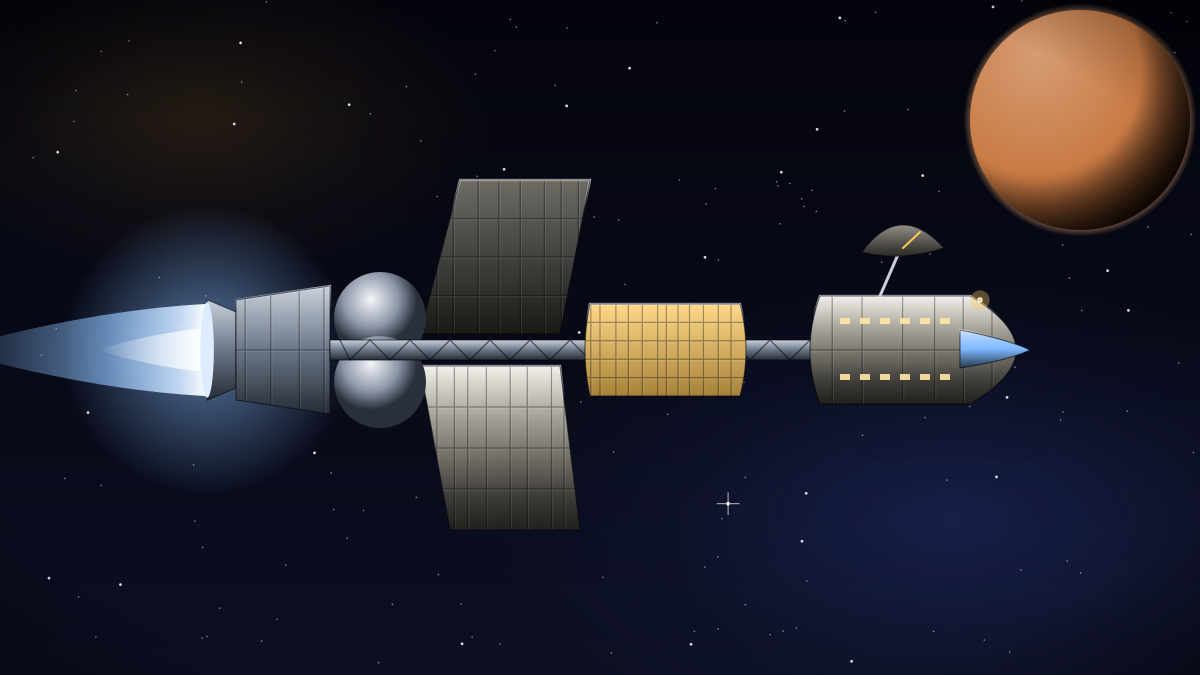
The hardest requirement on the Odyssey Deep Explorer was never the drive. A 920 km/s helium-3 fusion engine with a range of 1,800 AU is impressive, but propulsion is a problem we know how to solve. The hard part was keeping 18 people healthy for six years on a ship that may be more than 30 AU from the nearest spare part.
The Odyssey's habitat is built around three nested loops. The air loop scrubs carbon dioxide with regenerable amine beds and splits it back into oxygen and carbon using a solid-oxide electrolysis stack. The water loop recovers 99.2 percent of all water aboard, including humidity from breath and sweat. The food loop is the most ambitious: a 400-square-metre grow deck produces roughly 70 percent of the crew's calories from dwarf wheat, potatoes, soy, algae and insect protein.
No loop is perfectly closed, so the ship carries buffers. The Odyssey launches with about 1,200 tonnes of cargo capacity, and on a typical ice-giant mission around 300 tonnes of that is consumables: dried food, nitrogen to make up for airlock losses, spare membranes and seeds. The rest goes to science payloads, landers and probes.
Redundancy is handled differently from inner-system ships. Instead of carrying duplicate machines for everything, we carry the ability to make them. The Odyssey has a fabrication bay with metal and polymer printers and a library of more than 22,000 certified part files. During the 2184 Triton expedition, the crew printed and installed a replacement water-pump impeller 900 days into the mission. That one part, had it not been printable, could have ended the expedition.
We also learned that the human loop matters as much as the chemical ones. Six years with the same 17 colleagues is a long time. The habitat has private sleeping cabins for every crew member, a garden that doubles as a quiet space, and a ship schedule that guarantees each person two unstructured days in every ten. The four pilots rotate through science duties when the ship is coasting so nobody spends years staring at a nav console.
What still leaks? Nitrogen, mostly, at about 40 kilograms a year, and morale in the third year, which every long-duration crew reports. We are working on both. The next Odyssey block will add a nitrogen recovery stage, and our design team is testing a reconfigurable commons deck so the ship's interior can change over the course of a mission. If you have flown long-duration and have opinions, our systems team in Valparaíso would love to hear them.