Blog post
Diving into Jupiter: the structural engineering of the Nimbus Gas Skimmer
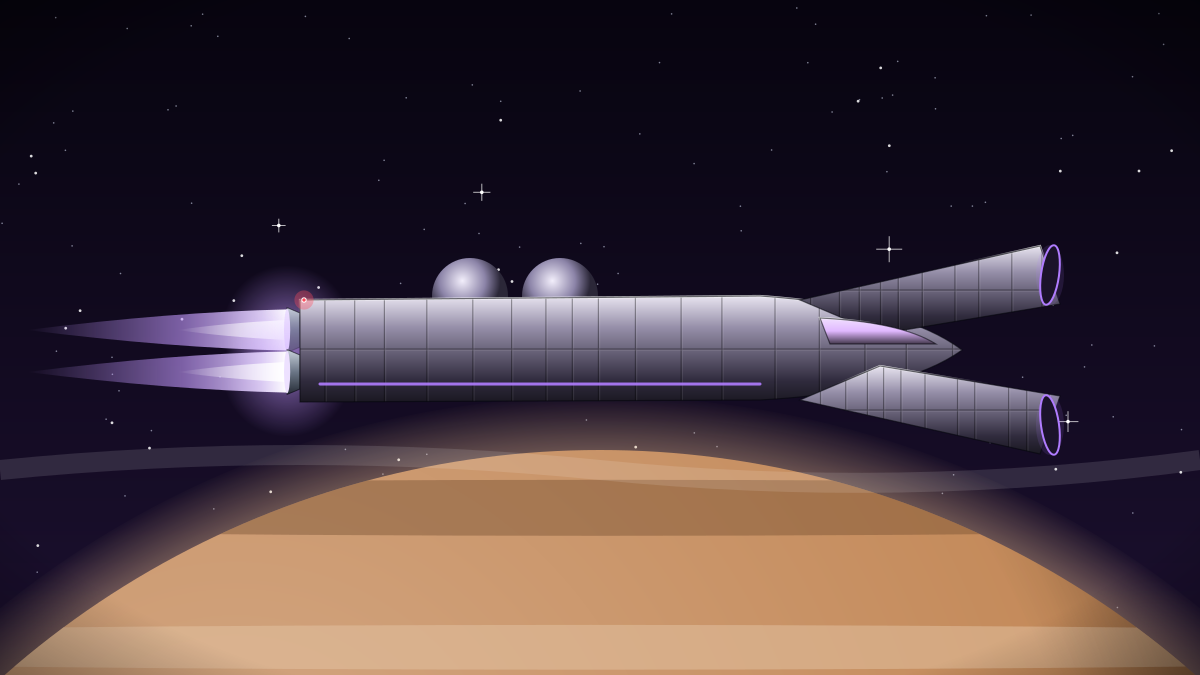
The Nimbus Gas Skimmer has the most violent job in our fleet. Several times a week, a Nimbus drops from orbit into the upper atmosphere of Jupiter or Saturn at tens of kilometres per second, opens its intake, scoops hydrogen and helium for a few minutes, and climbs back out. As the structural engineer responsible for its hull, I can tell you that those few minutes drove almost every design decision on the ship.
The Nimbus is 240 metres long and flown by two pilots, with a crew of six. Its distinctive shape, a flattened lifting body with a wide ventral intake, exists to manage heat and load. At the bottom of a Jupiter pass the hull's leading edges reach around 2,300 degrees Celsius, and the ship experiences peak loads of about 4 g along its spine. That is gentle for the crew but punishing for a structure that also has to carry a 9,000-tonne tank.
We handled heating with active cooling rather than ablative shields. Hydrogen from the intake is routed through channels behind the leading edges before it reaches the separator and the fusion ramjet. The incoming gas absorbs heat, the hull stays within limits, and the warmed hydrogen burns more efficiently in the ramjet. It is one reason the Nimbus achieves an exceptional fuel figure of 0.6 tonnes per 100 AU: much of its propellant is collected in situ during each pass.
Loads were harder. A full tank changes the ship's mass and centre of gravity dramatically during a single pass, so the structure must tolerate the worst combination of loads at every point in the dive. We ran more than 18,000 simulated passes through modelled Jovian weather, including updraft shear near storm systems, before cutting the first frame at our Osaka engineering centre.
Fatigue is the long-term enemy. Every pass flexes the spine slightly, and over thousands of passes that adds up. Each Nimbus carries more than 6,000 embedded strain sensors, and the onboard autonomy system compares every pass with the ship's history. When a frame begins to drift outside its expected behaviour, it is scheduled for inspection at the next servicing stop near Io.
Since its first flight in March 2185, the Nimbus fleet has completed over 3,400 atmospheric passes without a structural failure. At 235 Mc per ship, it has become the cornerstone of the system's helium-3 supply, and every pellet burned in an Atlas or Odyssey likely began in a Nimbus intake.