Blog
Mission log: twelve hours over Triton with the Odyssey Deep Explorer
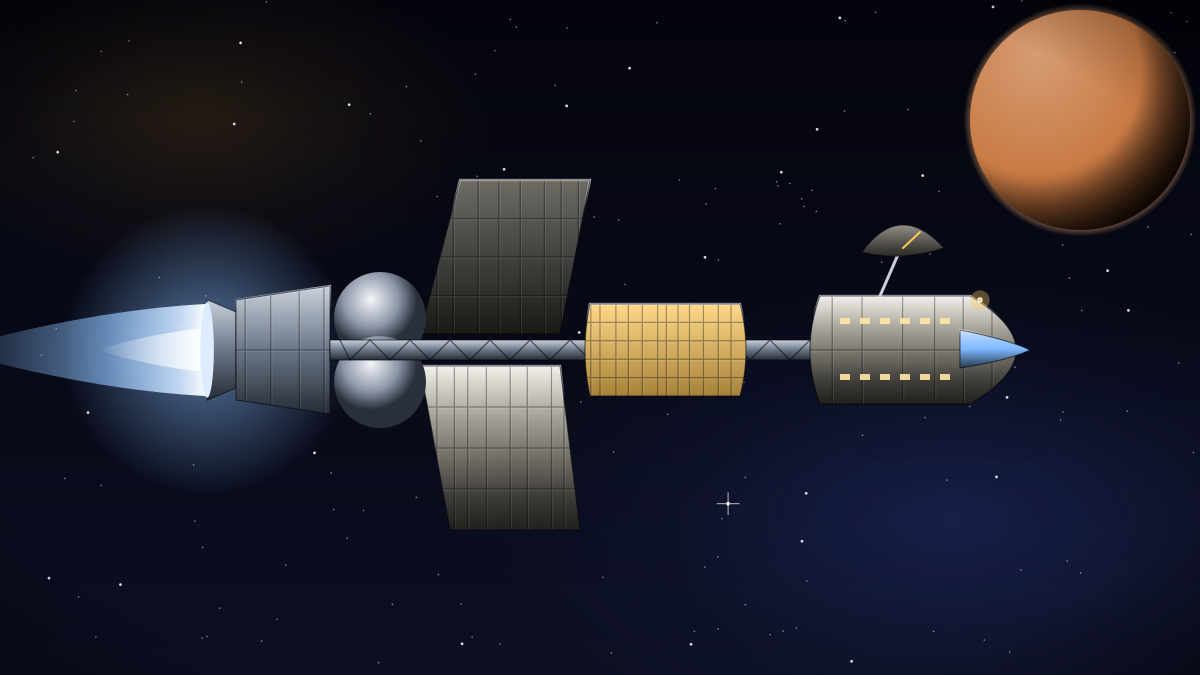
Mission control for an ice-giant flyby is a strange job. By the time any telemetry reaches us at Shackleton Base, the event it describes happened about four hours earlier. We are not flying the Odyssey Deep Explorer; its four pilots and fourteen other crew are. Our job is to watch, verify and be ready with answers before they are asked.
T-minus 6 hours. The Odyssey was sitting on its final approach corridor, 1.4 million kilometres out from Triton, after a cruise of almost three years from the Jovian system. The helium-3 fusion drive was idling. On an expedition like this, fuel discipline is everything: the Odyssey sips about 0.85 tonnes of pellets per 100 AU, and the flight plan budgets every one of them, because the 1,800 AU design range is a ceiling, not a target.
T-minus 2 hours. Commander Ilse Varga's crew powered up the forward survey array and swung the 196-metre hull broadside to Triton. Our flight dynamics desk confirmed the corridor was within 300 metres of nominal. Nobody in the room said anything for a long time. Triton's geysers had been on everyone's mind for months.
Closest approach. Altitude 1,180 kilometres. The first frames came down at 14:02 Luna time: nitrogen plumes rising eight kilometres above the cantaloupe terrain, shadows stretching across the south polar cap. The science team counted 41 active vents, more than twice what remote survey had predicted. One of our junior controllers started crying. I may have too.
T-plus 4 hours. The crew sampled plume fallout with a tethered collector and stowed it in the cold hold, part of the Odyssey's 1,200 tonnes of cargo capacity that this mission devoted almost entirely to instruments and sample storage. The ship's closed-loop habitat reported nominal across the board: water recovery at 98.7 percent, all 18 crew in good health.
T-plus 12 hours. With the moon receding, the Odyssey executed a 22-minute burn to bend its trajectory toward the Neptune trojans. That burn used less propellant than the planners had allowed, which buys the crew options later in the expedition. The raw flyby dataset, roughly 380 terabytes, will be published through our open data programme once the science team finishes calibration.
People sometimes ask whether watching from Luna is a let-down compared to flying. It is not. When a ship that we designed, built and certified carries eighteen people to the edge of the planetary system and brings back images nobody has ever seen, every desk in that control room has a piece of it.