Blog
Test pilot notes: the day the Eidolon unfurled
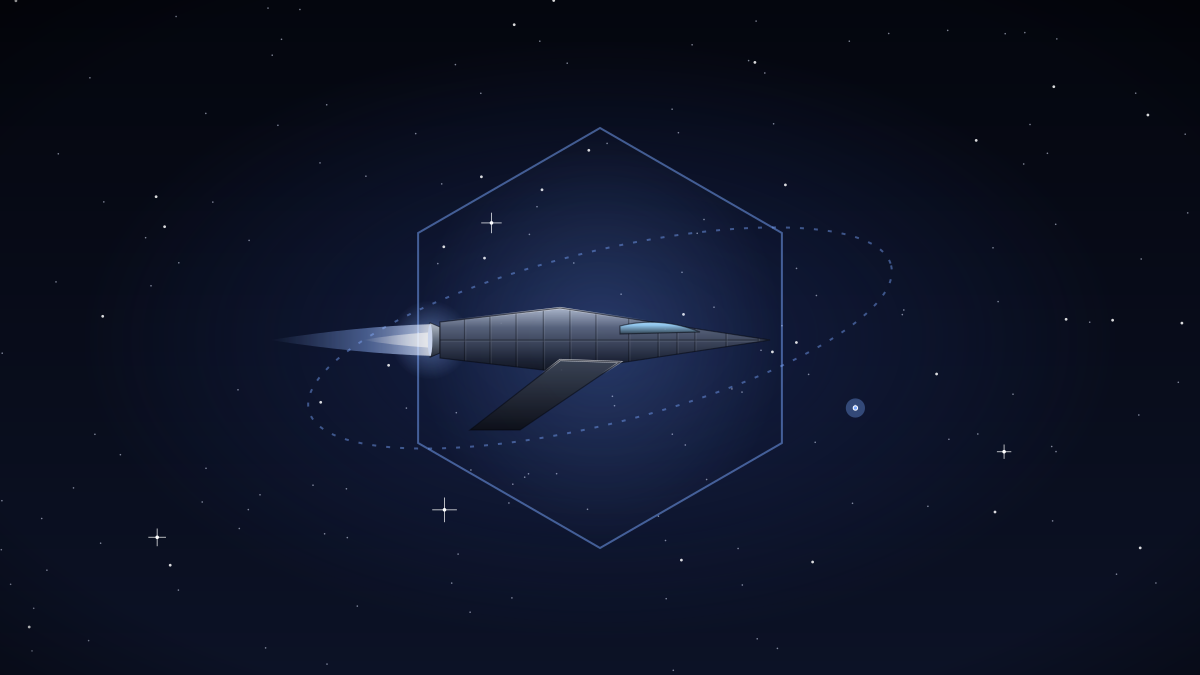
I have flown everything Halcyon makes, from the Wren Microlifter to the Starliner. The Eidolon Lightsail Prototype is the first ship where my hands were not on a throttle, because there is no throttle. Once the sail is out, your engine is a laser array several hundred thousand kilometres away, and your job is to keep the ship pointed while it pushes.
The first flight in March 2187 was a systems shakedown on helium-3 trim thrusters only. The deployment test came later, at a parking orbit trailing L5 Lagrange Station. The sail, 640 metres across when fully extended, is folded into a cylinder not much larger than a Kestrel shuttle. Unfurling it takes 47 minutes, and for most of that time the ship is at its most fragile.
We had rehearsed it more than 200 times in the simulator. The real thing was quieter than any rehearsal. You feel the boom motors through the seat as faint ticks. The sail's tension sensors scroll across the left display, and the support crew of four aboard the command module call out each quadrant as it locks. At minute 31, quadrant C stalled for nine seconds. Nine seconds is a very long time when you are watching a membrane thinner than a soap bubble.
It released on its own, as the autonomy team said it would. The fault turned out to be a thermal snag on the fold line, and the onboard planner had already re-sequenced the remaining quadrants to reduce load. I did not have to touch anything. That is the hardest skill on the Eidolon: knowing when not to fly.
Then the array lit us up. Acceleration on the first pulse was barely perceptible, a gentle pressure, like a hand on your back. Over the following six hours the ship gained more velocity than an Aurora Mk II courier can reach at full burn. The long-term target is a cruise at 14,800 km/s, and the current design range is expressed, a little absurdly, as 265,000 AU: enough to reach Proxima Centauri b.
A word on the support crew, because the press coverage tends to forget them. The four specialists in the command module spent the entire deployment monitoring sail tension, boom temperatures and the laser array link. Any one of them could have aborted the sequence with a single command. Their calm, clipped callouts are the reason the cockpit felt quiet. Flying a prototype is a team sport, even when the cockpit only has room for one.
Nobody is flying to Proxima in this ship. Eidolon is a prototype, and its job is to teach us what breaks. On deployment day the answer was: less than we feared. The next test will push the sail to a higher power density and keep it there for a week. I have already asked to fly it.