Blog post
Following a fusion pellet from Saturn to the drive core
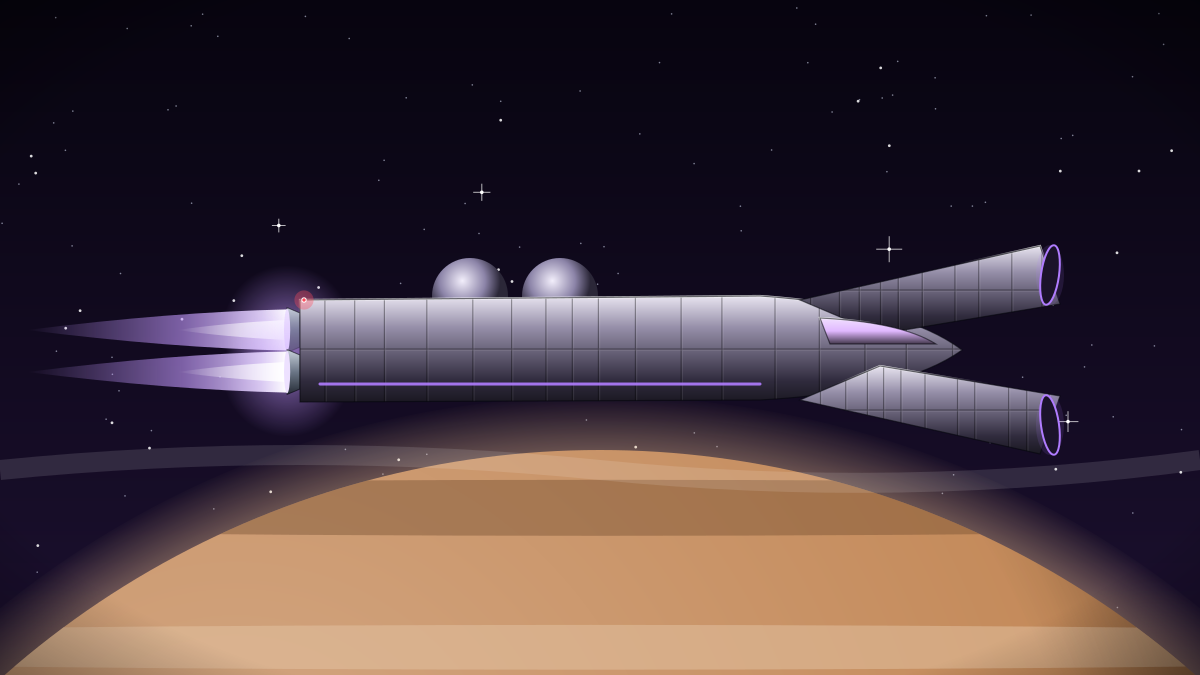
Eight of our nineteen ship types burn some form of helium-3. The Atlas, Odyssey, Starliner, Valkyrie, Corvid and Meridian Ark all run on pressed helium-3 fusion pellets, the Aurora Mk II uses a deuterium-helium-3 blend, and even the Eidolon lightsail carries helium-3 trim thrusters. That makes the pellet supply chain the single most important thing in our business that we do not fully control. I want to walk through it, because buyers deserve to understand what sits behind their fuel bill.
A pellet's journey begins in an upper atmosphere, usually Saturn's, where a Nimbus Gas Skimmer dives at orbital speed and scoops hydrogen and helium through its intake. The Nimbus separates helium-3 cryogenically aboard, filling its 9,000-tonne tank with a mix that is enriched a few hundredfold before it ever leaves the planet. The skimmer feeds its own fusion ramjet from the same intake, consuming just 0.6 tonnes of fuel per 100 AU, so its operating cost is mostly crew and wear.
From orbit, the enriched gas goes to a refinery, where it is purified and frozen into pellets of deuterium and helium-3 bound in a thin lithium shell. Each pellet is about the size of a grain of rice. The pellets are packed in cryogenic magazines and shipped inward, often aboard a Tempest Ice Runner or an Atlas returning from the Belt.
Here is roughly how a tonne of pellets is priced by the time it reaches L5:
- Skimming and separation: 22 percent
- Refining and pellet pressing: 31 percent
- Transport inward: 27 percent
- Insurance, storage and certification: 20 percent
Transport is the line we can influence most. By coordinating Atlas backhauls, we have reduced the inward leg's cost by about 15 percent since 2184.
The real issue for operators is volatility, not price. In 2183 a refinery outage at Titan doubled spot pellet prices for four months, and several freight partners parked ships rather than fly at a loss. Since then Halcyon has offered fixed-price pellet contracts bundled with new ships, backed by strategic reserves at L5, Luna and Olympus Ring. About 60 percent of new Atlas buyers now take one.
Fuel economy remains our best defence. Our drives keep getting more frugal: the Odyssey consumes just 0.85 tonnes per 100 AU, less than half what an equivalent hull needed a decade ago. Every tenth of a tonne we save in the drive core is a tenth of a tonne nobody has to skim, press and fly across the solar system.