Blog
A letter from our CEO: why a shipyard should reach for another star
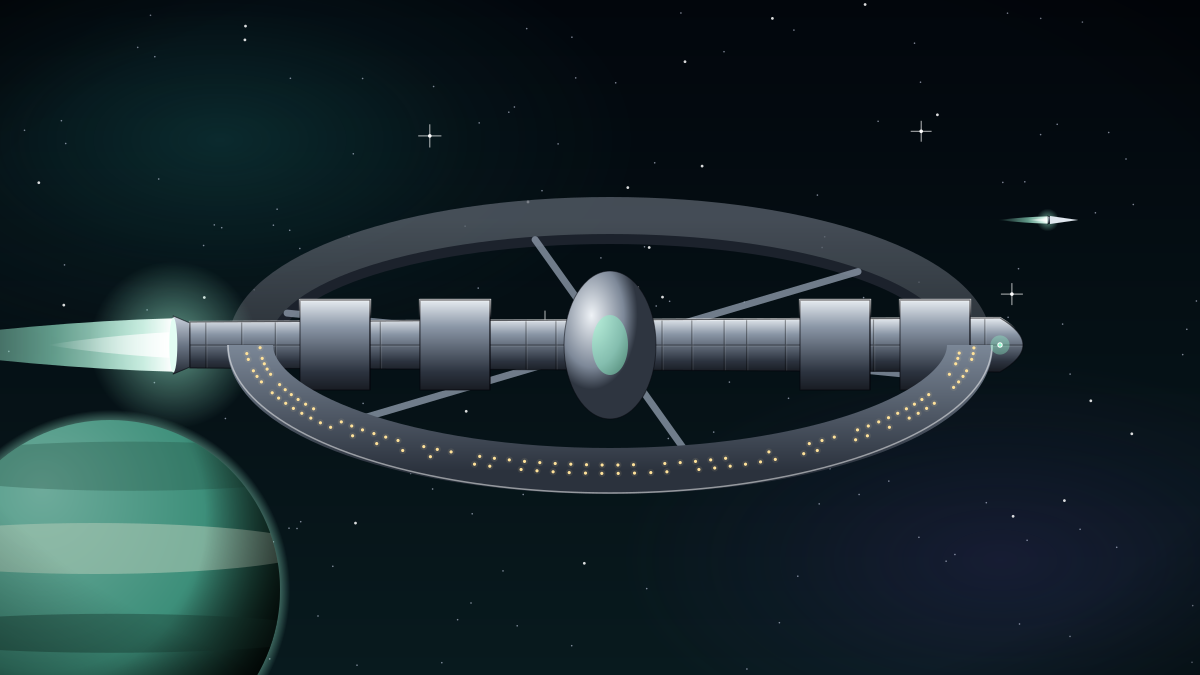
Every few months an investor asks me some version of the same question: why is a profitable shipyard, with freighters, liners and ore carriers booked out to 2191, pouring money into a craft that will not carry a single paying tonne? The question is fair, and I want to answer it in public, because the answer explains who we are.
The Eidolon Lightsail Prototype cost us 3,400 million credits to commission. That is more than eight Atlas Heavy Freighters, and roughly a third of what a single Meridian Colony Ark costs at 8,950 Mc. It flies with one pilot and a support crew of four, it has almost no cargo hold, and its 640-metre sail exists to do one thing: prove that a laser-pushed vessel can be accelerated, steered and kept alive on a trajectory toward Proxima Centauri b, 4.2 light-years from the Sun.
Our first answer is commercial. Every system aboard Eidolon is a stress test for the ships we sell today. The radiation shielding Dmitri Volkov's team developed for the sail's long coast is already being retrofitted into the Seraph Medevac. The navigation stack that holds Eidolon's attitude to a few microradians at 14,800 km/s is the same family of software that now lands the Cascade Dropship in Titan's haze. Ambition at the edge pays for itself in the middle of the catalogue.
Our second answer is about people. Kepler Yards employs engineers from Toulouse, Nairobi, Osaka, Austin and Valparaíso, and every one of them could work somewhere easier. They chose a company that intends to put a human footprint around another star. You do not keep talent like that by building only what the market asked for last quarter.
Our third answer is about responsibility. The Meridian Colony Ark already carries 4,800 settlers and 260,000 tonnes of equipment to Mars, Titan and Ganymede. Settlement is no longer speculative; it is a logistics problem we solve every month. Someone will eventually solve it for another star system, and I would rather that work be done in the open, with published safety data and shared standards, than in secret.
I will be honest about the limits. At Eidolon's current top speed the crossing would still take more than eight decades. The prototype is not the ship that will make that journey. It is the ship that tells us whether the next one is worth building, and what it should look like.
So, to the investors, partners and staff who keep asking: yes, we are going to keep building freighters, and yes, we are going to keep reaching for Proxima. The two are not in tension. They are the same company, looking in the same direction, at different distances.