Blog post
Through the haze: training crews for the first Cascade landings on Titan
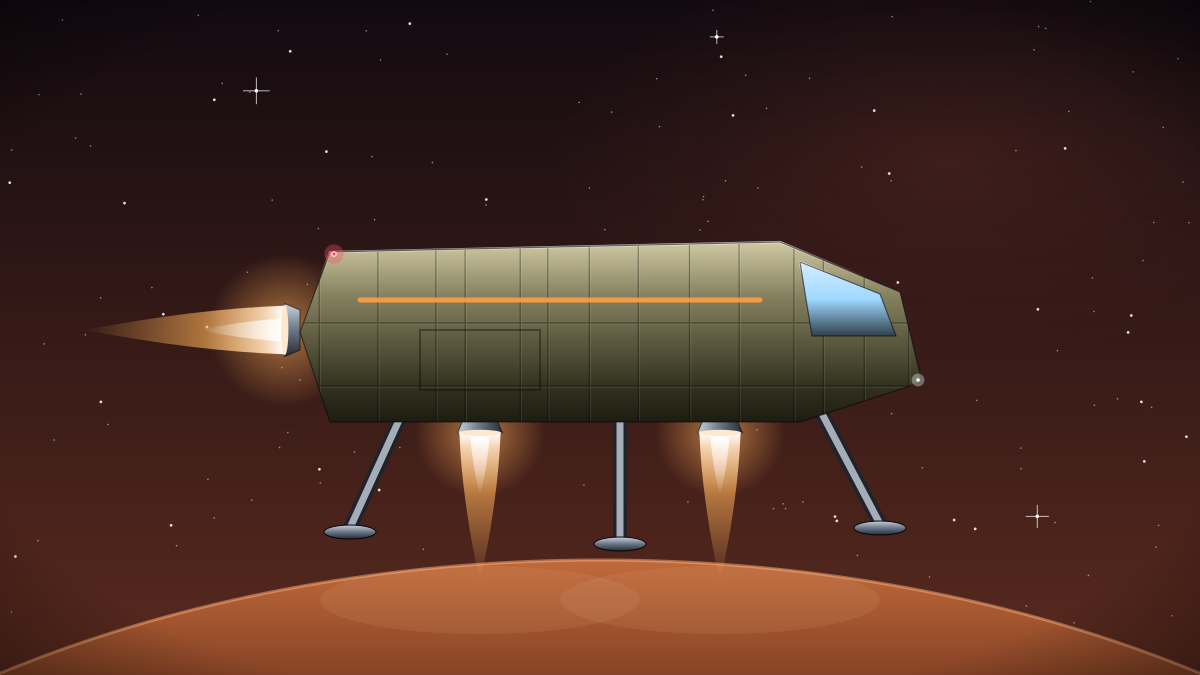
Titan is the friendliest place in the solar system to land and the hardest place to see. Its atmosphere is one and a half times as dense as Earth's, which means parachutes and aerobraking do a lot of the work. It is also filled with photochemical haze, which means that for the last 40 kilometres of a descent, your eyes are mostly useless.
When the first Meridian Colony Ark arrived in Titan orbit, it needed a way to move people and equipment to the surface. That job fell to the Cascade Dropship, our heavy lander. A Cascade carries up to 60 passengers or 220 tonnes of cargo, is flown by two pilots, and climbs back to orbit on methalox. Its range is only 12 AU, but on Titan nobody cares about range. They care about the last 400 metres.
Our training programme for Titan crews ran for eleven weeks at the Oceania simulator centre. We built a haze model from Valkyrie survey data and ran every crew through 140 simulated descents, including engine-out, radar dropout and unexpected methane rain. The Cascade's 18 tonnes per 100 AU fuel figure looks alarming on paper; in practice, almost all of that is spent in the ascent, so we trained crews to treat every gram of reserve as sacred.
The most important lesson was trust in instruments. The Cascade's terrain-relative navigation fuses radar, lidar and a pre-loaded map. In the simulator, experienced pilots kept trying to look out of the window. By week six they had stopped. By week nine they were landing within 15 metres of the target in zero visibility.
The first real landing happened on a dune field near the colony site. Captain Rhys Okoro and his co-pilot brought 52 settlers down in a single sortie and touched down 9 metres from the beacon. The crew's comment over the radio was simply, 'Same as the sim.' For a trainer, there is no better review.
We have also learned a great deal about the ship itself. Titan's cold soaks the landing gear to temperatures far below anything the Cascade sees on Mars or Luna, and early sorties showed seal wear on the hydraulic struts. Ground crews now pre-heat the gear before every descent, and the next production batch will ship with redesigned seals. Feedback from crews flows directly into our engineering reviews; that loop is a big part of why the Cascade keeps getting better.
Since then, Cascade crews have flown more than 300 sorties between the ark and the surface. We still run every new crew through the full eleven weeks.