Partner
Lumen Interstellar Institute
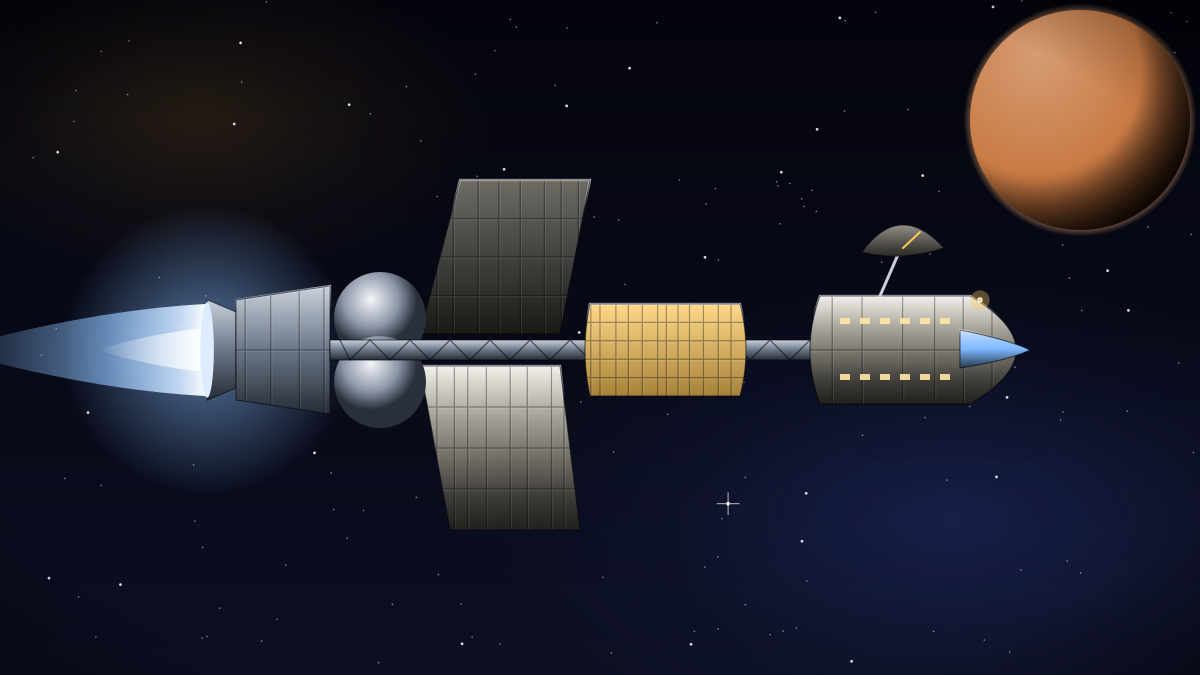
The Lumen Interstellar Institute exists for one reason: to send people to another star. Chartered at L5 Lagrange Station in 2163 by a consortium of 34 universities and observatories, the Institute funds propulsion research, deep-space medicine and the long-baseline astronomy needed to characterise Proxima Centauri b, 4.2 light-years away.
Lumen is the launch customer and research partner for the Eidolon Lightsail Prototype, the only example ever built. The Eidolon carries no propellant for its main drive: a 640-metre sail is pushed by ground- and orbit-based laser arrays to a design cruise of 14,800 km/s, with helium-3 trim thrusters for steering. Its theoretical reach of 265,000 AU is what makes a Proxima mission conceivable. The 3,400 million credit commissioning fee was split between the Institute, the L5 station authority and Halcyon itself.
Two Odyssey Deep Explorers act as the Institute's long-range laboratories. With an 1,800 AU range, four pilots and a habitat for 18 crew, they carry instrument packages to the edge of the heliosphere and beyond Neptune, testing shielding and navigation that a Proxima ship will one day rely on. A Polaris Relay Tender maintains the Institute's laser-relay satellites near Triton.
The Institute publishes everything it learns. Sail-material fatigue data, crew-health records from Odyssey voyages and laser-array calibration logs all go into Halcyon's open data catalogue, so that any team anywhere can build on Lumen's work.
In 2187 the Eidolon completed its first powered sail test beyond Neptune's orbit, reaching 2 percent of its design velocity. Kwame Asante, Halcyon's lightsail research lead, sits on the Institute's science board.