Blog post
Ion or fusion? Why the Polaris Relay Tender runs on xenon
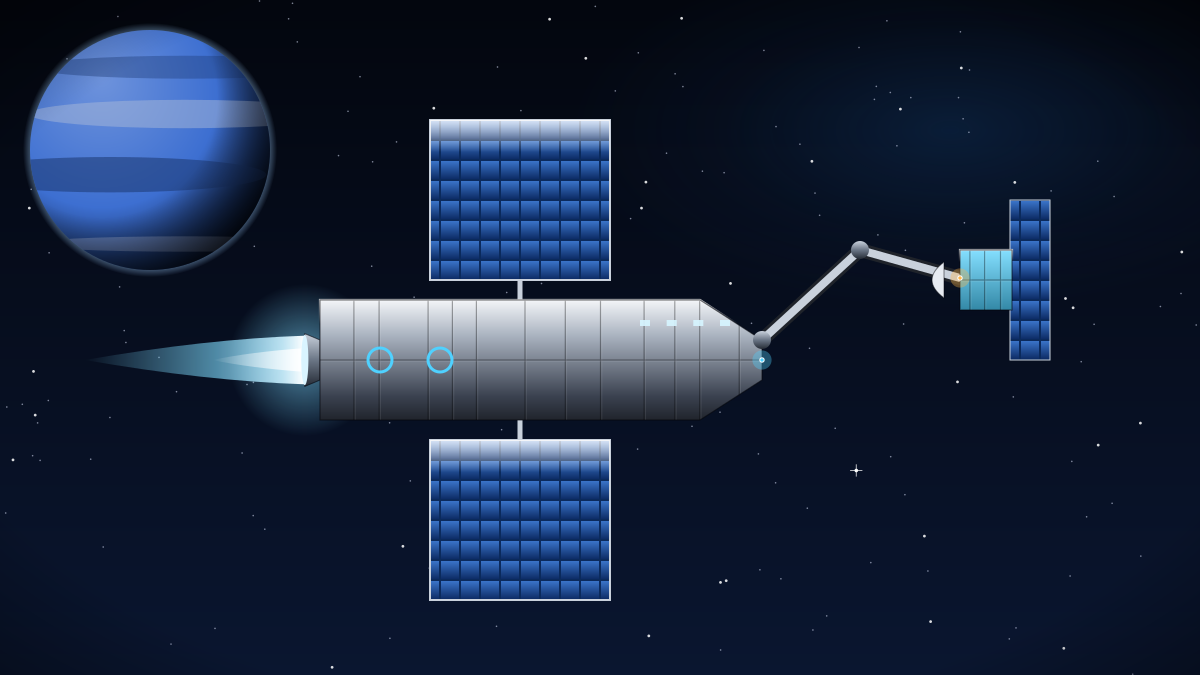
When the Polaris Relay Tender program began in 2180, the obvious choice was to borrow the helium-3 fusion drive from the Valkyrie Survey Corvette. The two ships are similar in size, 88 metres versus 92, and both fly with two pilots. The Valkyrie drive was proven, and reusing it would have saved roughly two years of development. We chose xenon ion propulsion instead. Five years into service, I am confident it was the right call.
The deciding factor was the mission profile. A survey corvette spends its life travelling: it crosses to a moon or asteroid field, maps it, and moves on, covering up to 220 AU in its service life. A relay tender spends most of its time doing something very different: matching orbits with satellites, holding position a few metres away while its robotic arms work, and then making a small transfer to the next satellite in the constellation. It needs gentle, precise, continuous thrust far more than it needs speed.
Ion thrusters are excellent at exactly that. The Polaris's four gridded thrusters can deliver thrust in increments small enough to hold station within 2 centimetres of a satellite for hours. A fusion drive, even throttled down, has a minimum stable thrust well above what close-proximity operations require, so a fusion Polaris would have needed a separate cold-gas system for station-keeping anyway.
Efficiency was the second factor. The Polaris uses 1.4 tonnes of xenon per 100 AU. That is not much less than the Valkyrie's 1.9 tonnes of helium-3, but xenon is inert, storable for decades without boil-off, and available at every major depot. Its plumes also do not contaminate the delicate optics of the satellites being serviced, something a fusion exhaust would make far harder.
The trade-off is speed. The Polaris tops out at 330 km/s, compared with the Valkyrie's 860. For a constellation spread across Mars orbit or the Jovian moons that rarely matters, because transfers between neighbouring satellites are short. For emergency repairs on the far side of the system, operators sometimes charter an Aurora Mk II to carry spare parts ahead while the tender follows.
The same reasoning later shaped the Gravitas Dock Barge, which also uses xenon ion propulsion for fine control of enormous loads. When the job is precision rather than distance, ion propulsion wins.
At 118 Mc, the Polaris is now servicing more than 900 satellites across the system, including the comms relays above Phobos and the deep-space network around Jupiter.