Blog post
Radiation shielding across the fleet, from a 14-metre lifter to a six-year explorer
Radiation is the one hazard in spaceflight you cannot see, hear or smell, and it is the one that most shapes long-term crew health. My team in the radiation protection group on Luna sets the shielding requirements for every Halcyon ship. People are often surprised by how different those requirements are from ship to ship, so here is how we think about it.
Our baseline is a career dose limit for crew of 600 millisieverts, with an annual limit of 50 millisieverts for routine operations. Whether a ship meets that depends on two things: how long people spend aboard, and where it flies.
At one extreme is the Wren Microlifter. A Wren sortie lasts a few hours, mostly inside a planetary magnetic field or below the horizon of a large body. Its 14-metre hull has only modest polymer shielding, because adding mass to a single-pilot lifter costs more in fuel than it saves in dose. A Wren pilot flying daily sorties typically accumulates around 8 millisieverts a year.
At the other extreme is the Odyssey Deep Explorer, which can keep 18 people in deep space for six years. For the Odyssey we combine three layers:
- A hydrogen-rich polymer liner throughout the habitat.
- A water jacket around the sleeping quarters, using part of the ship's water reserve as shielding.
- A storm shelter at the ship's core, surrounded by the food stores and the 1,200-tonne cargo bay, where the whole crew can retreat during a solar particle event.
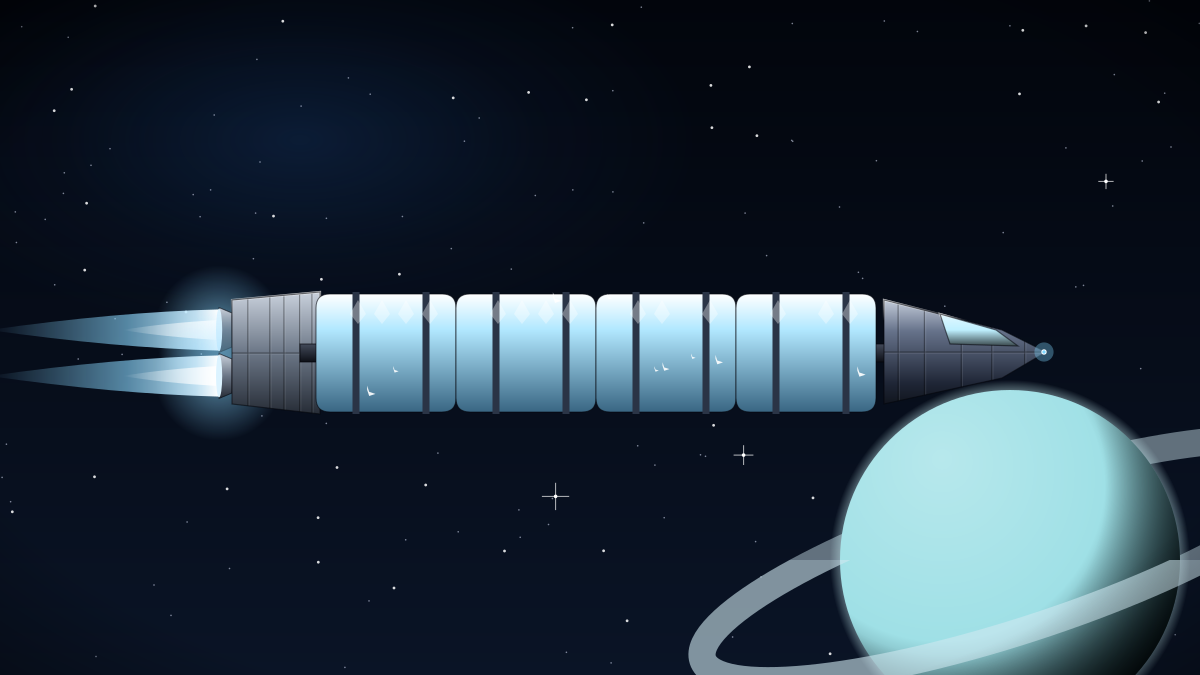
The Tempest Ice Runner gave us a pleasant surprise. Its job is to carry up to 38,000 tonnes of water ice from Saturn and Enceladus inward. Fully loaded, the ice surrounds the crew module and provides better shielding than anything we could afford to build in. Tempest crews have the lowest average doses of any long-haul ships we track, about 11 millisieverts a year, even on runs past Jupiter's radiation belts.
Jupiter is the hardest environment we design for. Crews visiting Europa or Io face trapped-particle radiation that can exceed a year's dose in days. Ships operating there, including the Valkyrie Survey Corvette and the Nimbus Gas Skimmer, carry extra shielding around the flight deck and follow trajectories that minimise time in the inner belts.
Shielding is never free. On the Odyssey it accounts for roughly 9 percent of dry mass. But we would rather spend mass than spend crew health, and every ship we deliver comes with a radiation exposure model tailored to its operator's routes.